

We now offer Virtual Mediations using Enhanced Video Conferencing
Originally published: June 2026 | Updated: July 2026
By Ann M. Goade, Esq., Florida Supreme Court Certified Family Mediator and Family Law Attorney
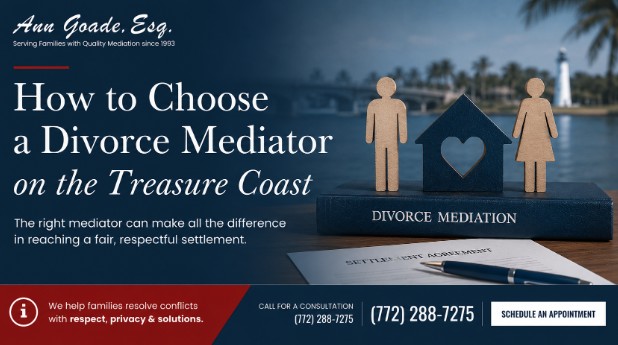
Florida Supreme Court family certification is the single most important credential when choosing a divorce mediator on the Treasure Coast.
Florida Family Law Rule 12.740 requires courts to refer contested family law cases to certified mediators before trial, and only mediators holding active Florida Supreme Court family certification can handle divorce, custody, and support disputes.
In 2026, private mediators in the 19th Judicial Circuit charge $150–$400 per hour. You can verify any mediator’s status for free at the Florida Dispute Resolution Center’s online directory.
Choosing a mediator for your Treasure Coast divorce and want to confirm you are working with a certified professional? Ann M. Goade, Certified Family Law Mediator, offers free consultations across Martin and Palm Beach Counties — schedule yours today.
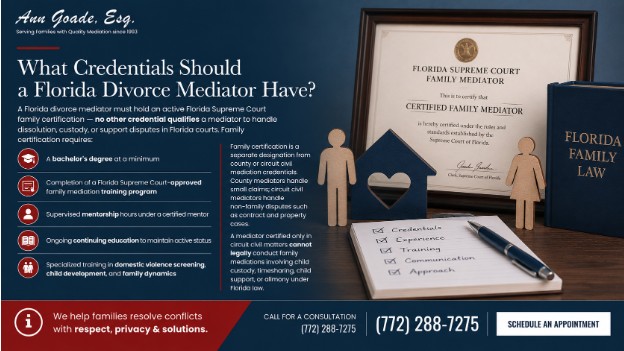
A Florida divorce mediator must hold an active Florida Supreme Court family certification — no other credential qualifies a mediator to handle dissolution, custody, or support disputes in Florida courts. Family certification requires:
Family certification is a separate designation from county or circuit civil mediation credentials. County mediators handle small claims; circuit civil mediators handle non-family disputes such as contract and property cases.
A mediator certified only in circuit civil matters cannot legally conduct family mediations involving child custody, timesharing, child support, or alimony under Florida law.
The Florida Supreme Court requires the specialized training components listed above because family mediations involve vulnerable parties and binding agreements that directly affect children’s welfare and long-term parental rights. General civil mediators are not required to complete domestic violence screening or child development coursework.
Private divorce mediators on the Treasure Coast charge $150–$400 per hour in 2026, with most practitioners in Martin County and St. Lucie County billing $200–$350 per hour.
A straightforward half-day session runs $600–$1,400 total for both parties, while complex cases involving contested custody or high-asset estates may require multiple sessions totaling $3,000–$8,000 combined.
Court-connected mediation through the 19th Judicial Circuit offers significantly lower rates for eligible families.
Income-based fees start at approximately $60 per person per session for households earning under $50,000, rising to $120 per session for those earning $50,000–$100,000. Parties who qualify as indigent receive mediation at no cost.
| Cost Factor | Private Mediator | Court-Connected |
| Hourly rate | $150–$400 | Not hourly (flat per session) |
| Per-session cost (both parties) | $600–$1,400 | $120–$240 |
| Total for the simple case | $1,500–$3,000 | $120–$480 |
| Total for complex case | $5,000–$8,000 | $240–$960 |
| Free consultation availability | Varies by mediator | Not typically offered |
Mediator fees are separate from attorney fees. Spouses who hire attorneys to advise them during or after mediation pay those attorney fees on top of the mediator’s charges.
Pro se parties — those proceeding without attorneys — pay only the mediator’s cost and court filing fees.
If you’re ready to get started, call us now!
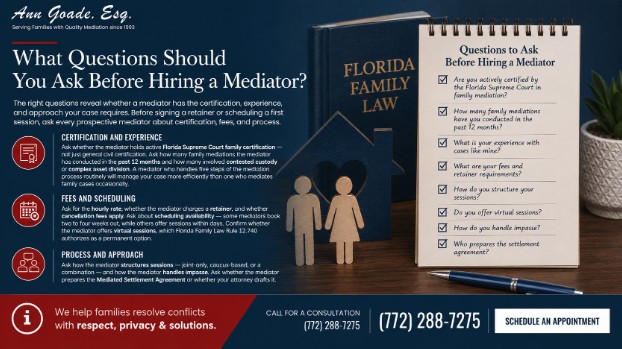
The right questions reveal whether a mediator has the certification, experience, and approach your case requires. Before signing a retainer or scheduling a first session, ask every prospective mediator about certification, fees, and process.
Ask whether the mediator holds active Florida Supreme Court family certification — not just general civil certification. Ask how many family mediations the mediator has conducted in the past 12 months and how many involved contested custody or complex asset division.
A mediator who handles five steps of the mediation process routinely will manage your case more efficiently than one who mediates family cases occasionally.
Ask for the hourly rate, whether the mediator charges a retainer, and whether cancellation fees apply. Ask about scheduling availability — some mediators book two to four weeks out, while others offer sessions within days.
Confirm whether the mediator offers virtual sessions, which Florida Family Law Rule 12.740 authorizes as a permanent option.
Ask how the mediator structures sessions — joint-only, caucus-based, or a combination — and how the mediator handles impasse. Ask whether the mediator prepares the Mediated Settlement Agreement or whether your attorney drafts it.
Together, certification, fee, and process questions determine whether the mediator’s style aligns with your case needs and communication preferences.
A mediator does not need to be a licensed attorney in Florida — family certification requires a bachelor’s degree, not a law degree. Mediators who are also attorneys bring legal knowledge to the table, but they cannot give legal advice to either party during the mediation session, regardless of their background.
The practical advantage of an attorney-mediator is issue recognition. An attorney-mediator may spot tax implications in a proposed property split or identify a child support calculation error that a non-attorney mediator might not flag.
The mediator cannot advise either spouse on how to respond — but identifying the issue allows both parties to consult their own attorneys before finalizing terms.
Non-attorney mediators with deep family mediation experience often bring equally strong facilitation skills and subject-matter knowledge. The critical credential remains Florida Supreme Court family certification, and attorney-mediator issue recognition is a secondary advantage — not a substitute for case-specific experience and communication style in your selection decision.
When your Treasure Coast divorce requires a mediator who understands local courts and contested family disputes, Ann Goade brings dual circuit civil and family certifications plus years of Palm Beach and Martin County experience — book a free consultation.
Court-appointed mediators are assigned by the judge from the circuit’s approved roster when the parties fail to agree on a mediator within 10 days of the referral order. Private mediators are selected directly by the parties — or recommended by their attorneys — before the court assigns one. Both must hold an identical Florida Supreme Court family certification.
| Factor | Court-Appointed | Private |
| Selection | The judge assigns from the roster | Parties choose |
| Cost | $60–$120/session (income-based) | $150–$400/hour |
| Scheduling flexibility | Limited by program capacity | Direct booking |
| Session format | Often fixed half-day blocks | Customizable |
| Virtual option | Varies by circuit | Typically available |
Court-appointed mediators handle high case volumes and may have less time per session than private practitioners.
Private mediators typically offer more scheduling flexibility, longer session windows, and the ability to customize the process — for example, caucus-heavy sessions for high-conflict cases or pro se accommodations for self-represented parties.
Choosing a private mediator early avoids the 10-day deadline and gives both spouses input on who will facilitate their case. Spouses who wait past the deadline risk assignment to a mediator neither party has vetted, which can reduce comfort and trust in the process.
If you’re ready to get started, call us now!
The Florida Supreme Court Dispute Resolution Center maintains a free online directory where anyone can verify a mediator’s certification status by name or certificate number.
The directory shows whether the mediator holds active family certification, the certification type (county, circuit civil, family, dependency, or appellate), and the most recent renewal date.
Check three things before hiring:
A mediator whose certification has lapsed cannot conduct binding family mediations in Florida courts.
Agreements mediated by an uncertified individual may face enforceability challenges under Fla. Stat. § 44.102. Verifying certification takes two minutes and eliminates the risk of working with an unqualified practitioner.
A mediator familiar with the 19th Judicial Circuit (Martin, St. Lucie, Indian River, and Okeechobee Counties) understands how local judges handle contested issues — knowledge that helps set realistic settlement expectations during mediation.
Judges in the 19th Circuit may apply Florida’s equitable distribution and timesharing statutes differently from judges in Palm Beach County’s 15th Circuit, and an experienced local mediator communicates those tendencies without providing legal advice.
Local experience also means familiarity with court-connected mediation program procedures, local filing requirements, and the specific forms each circuit clerk requires for mediation agreements to be incorporated into a final judgment.
A mediator based in Stuart or West Palm Beach who regularly files in the 19th and 15th Circuits can prepare agreements that meet each clerk’s formatting and procedural standards — avoiding delays and rejected filings.
Treasure Coast cases often involve cross-county logistics. Spouses may live in different counties, own property across Martin and Palm Beach jurisdictions, or have children enrolled in schools in one county while the other parent lives in a neighboring circuit.
A mediator with regional experience in family law efficiently navigates these multi-county issues.
What is the most important credential for a Florida divorce mediator?
Active Florida Supreme Court family certification is the only credential that authorizes a mediator to handle divorce, custody, and support cases in Florida courts. General civil or county mediation certification does not qualify. Verify active status at the Dispute Resolution Center directory before scheduling.
How much does a private divorce mediator cost on the Treasure Coast?
Private mediators in the 19th Judicial Circuit charge $150–$400 per hour in 2026. A half-day session for both parties runs $600–$1,400 total. Complex cases involving contested custody or business valuations may require three to five sessions, totaling $3,000–$8,000.
Can I use a court-appointed mediator instead of a private one?
Yes. The 19th Judicial Circuit assigns court-appointed mediators when parties cannot agree on one within 10 days. Court-connected programs charge $60–$120 per session based on income. Indigent parties receive free mediation. Court-appointed mediators hold identical certification from the Florida Supreme Court.
Does my mediator need to be a licensed attorney?
No. Florida requires family mediators to hold a bachelor’s degree and Florida Supreme Court family certification, not a law license. Attorney-mediators bring legal knowledge but cannot advise either party during sessions. Choose based on certification, family case experience, and communication style.
How do I verify a Florida mediator’s certification?
Search the mediator’s name or certificate number at the Florida Supreme Court Dispute Resolution Center directory at drc.flcourts.org. The directory confirms active certification status, certification type, renewal date, and any disciplinary history. Verification is free and takes approximately two minutes.
What happens if I do not choose a mediator within 10 days?
The court appoints a mediator from the circuit’s approved roster if parties fail to agree within 10 days of the referral order. The appointed mediator holds the same certification, but the parties have no input into the selection. Choosing a private mediator early preserves control over who facilitates the process.
Can I switch mediators after mediation starts?
Yes, though switching requires either agreement between both parties or a court order. Grounds for switching include mediator bias, scheduling conflicts, or a breakdown in the mediation process. The court may reassign the case to a new certified mediator upon motion by either party.
Should I choose a local mediator or one from another county?
A mediator familiar with the 19th Judicial Circuit’s local judges, filing procedures, and court-connected program rules brings practical advantages. Local mediators set more realistic settlement expectations because they understand how area judges typically rule on contested custody and equitable distribution disputes.
What is the difference between family certification and circuit civil certification?
Family certification authorizes mediation of disputes involving divorce, custody, timesharing, child support, and alimony. Circuit civil certification covers non-family matters such as contract, property, and personal injury disputes. A mediator holding only circuit civil certification cannot legally mediate family cases in Florida.
Can both spouses interview a mediator before hiring?
Yes. Reputable mediators offer joint or separate consultations so both parties can evaluate the mediator’s style, credentials, and fee structure before committing. A free consultation allows each spouse to ask about the mediator’s experience with confidential mediation and case-specific issues.
Do I still need an attorney if I hire a mediator?
A mediator facilitates negotiation but cannot provide legal advice to either spouse. Attorneys are not required during mediation sessions, but having one review the Mediated Settlement Agreement before signing protects each party’s legal rights. Pro se parties should consider, at a minimum, a one-time consultation with an attorney.
How long does mediation take on the Treasure Coast?
Simple cases with no children and limited assets resolve in one to two four-hour sessions. Moderate cases involving custody or significant assets require two to three sessions over four to eight weeks. Florida Family Law Rule 12.740 requires completion within 75 days of the first mediation conference.
Your Treasure Coast divorce deserves a mediator who knows Martin County courtrooms, Palm Beach filing requirements, and the 19th Circuit’s local procedures inside and out — Ann Goade offers a free consultation to help you decide whether mediation fits your case. Schedule yours now.


Proudly Serving Areas
Navigation
Practice Areas
Contact Us