

We now offer Virtual Mediations using Enhanced Video Conferencing
Originally published: August 2022 | Updated: May 2026
By Ann M. Goade, Esq., Florida Supreme Court Certified Family Mediator and Family Law Attorney
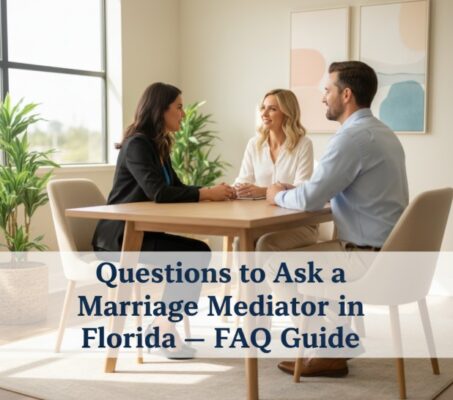
A Florida marriage mediator is a neutral facilitator who helps both spouses discuss and resolve issues like property, support, and custody. They don’t represent either party or decide the outcome—both spouses must agree to any settlement. Once signed and approved by the court, the agreement becomes enforceable.
In Florida, a mediator guides both spouses toward agreement but does not advocate for one side, whereas a lawyer represents a single client and manages court proceedings. Mediation often costs less and resolves matters faster than litigation.
When both spouses cooperate and documents are ready, mediation in Florida can be completed in 4-12 weeks. Complex financial or parenting issues can lengthen the process; by contrast, full litigation may take many months.

Yes. Confidentiality rules protect mediation discussions in Florida—what’s said in the session generally cannot be used in court. Only signed settlement terms become part of the public record when filed.
Mediation fees in Florida vary by region and mediator experience, typically ranging from $150 to $500 per hour for private sessions. Many couples finalize their matters in one or two sessions, making it far more economical than litigation.
Absolutely. Even without minor children, couples can use mediation in Florida to negotiate alimony, asset division, and debts. The process still applies and can be more efficient than court-driven litigation.
If you’re ready to get started, call us now!

Yes. Once both spouses sign the mediated agreement and a judge approves it, the settlement becomes a final judgment, enforceable as any other court order.
Ask: What training and certification do you hold? How many family law mediations have you completed? What is your hourly or flat rate? What is your approach to power imbalances or high-assets cases? These ensure transparency and fairness.
Mediation may not be appropriate if one spouse refuses to participate in good faith, there is domestic violence, coercive control, or a significant power imbalance. In such cases, legal or court intervention may be needed.
Yes. If mediation doesn’t result in a signed agreement, the case can revert to attorney negotiation or proceed to litigation. Mediation is voluntary and does not guarantee a resolution.
Gather financial records (tax returns, bank statements, retirement accounts), list assets and debts, prepare a parenting plan if children are involved, and set communication ground rules. Preparation boosts outcomes and speeds up the process.
Most mediated agreements include a modification clause. If life changes (job loss, relocation, health issues), couples may revisit the settlement through agreed procedures, which helps prevent future disputes or court modifications.

Editor’s Note: This article was updated in May 2026 to include new data and examples.

Proudly Serving Areas
Navigation
Practice Areas
Contact Us