

We now offer Virtual Mediations using Enhanced Video Conferencing
Originally published: February 2021 | Updated: September 2026
By Ann M. Goade, Esq., Florida Supreme Court Certified Family Mediator and Family Law Attorney
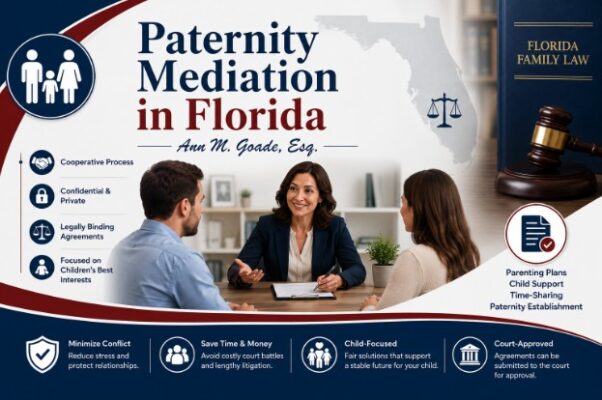
A Florida paternity action legally establishes who the child’s father is, as well as child support, parental responsibility, and a time-sharing schedule.
Unmarried parents can establish paternity through a voluntary acknowledgement form or a circuit court action under Florida Statute 742.011, but a parenting plan requires a separate step even after paternity is established.
Schedule a mediation with Ann M. Goade, Esq. to resolve paternity, support, and timesharing terms together.
A paternity action is a circuit court proceeding that legally determines who a child’s father is, along with that parent’s support and time-sharing rights.
Florida Statute 742.011 allows a pregnant woman, a man who believes he is the father, or the child to bring this proceeding when paternity has not already been established.
This mediation practice serves unmarried parents across Martin, Palm Beach, St. Lucie, and Indian River counties, applying the same statutory framework a judge would use in a contested family law proceeding.
Once paternity is legally established, the same action can also resolve child support and a timesharing schedule under Chapter 61, so unmarried parents leave mediation with a complete, enforceable agreement rather than a partial one.
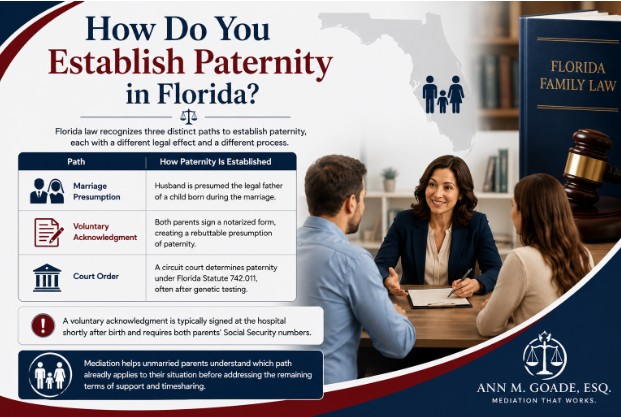
Florida law recognizes three distinct paths to establish paternity, each with a different legal effect and a different process.
| Path | How Paternity Is Established |
| Marriage presumption | Husband is presumed the legal father of a child born during the marriage |
| Voluntary acknowledgment | Both parents sign a notarized form, creating a rebuttable presumption of paternity |
| Court order | A circuit court determines paternity under Florida Statute 742.011, often after genetic testing |
A voluntary acknowledgment is typically signed at the hospital shortly after birth and requires both parents’ Social Security numbers.
Mediation helps unmarried parents understand which path already applies to their situation before addressing the remaining terms of support and timesharing.
No. Signing a voluntary acknowledgment of paternity establishes who the legal father is, but it does not, on its own, create a parenting plan, a timesharing schedule, or a child support order.
Florida Statute 742.10(5) requires that parental responsibility, child support, and a timesharing schedule be established through a separate action under Florida Statute 742.011, regardless of whether paternity was established by acknowledgment or by court order.
This means a father who signed an acknowledgment form at the hospital still has no enforceable right to time-sharing until that separate action resolves it.
Struggling to turn an acknowledged paternity into an enforceable parenting plan? Contact Ms. Goade to mediate the timesharing and support terms directly.
A Florida court can order the child, mother, and alleged father to submit to genetic testing when paternity is contested, using a qualified testing laboratory.
| Test Result | Legal Effect |
| 95% probability or higher | Creates a rebuttable presumption that the tested man is the biological father |
| Below 95% probability | Weighed as evidence alongside other proof of paternity |
| Excludes the tested man | The case is dismissed against the alleged father |
Florida Statute 742.12 governs this testing process and allows either party to request an additional test from an independent laboratory if the original results are disputed.
Genetic testing typically resolves the factual question of biological paternity, but mediation still addresses the support and timesharing terms that follow once parentage is settled.
Paternity mediation with Ms. Goade brings both parents together with a neutral, Florida Supreme Court-certified mediator to resolve support and timesharing terms directly, rather than litigating every issue in circuit court.
The mediator does not represent either parent and holds no financial interest in the outcome, so both sides negotiate on equal footing using the same statutory factors a judge would apply. Sessions can proceed through Pro Se mediation for parents without an attorney.
Virtual mediation is also available for parents who cannot attend in person. A finalized agreement is then submitted to the circuit court for approval.
Mediation is confidential, so parents can discuss sensitive paternity questions candidly without those statements being used against them in a later hearing if mediation does not resolve every issue.
Yes, but only within a limited window. Either parent may rescind a signed voluntary acknowledgment of paternity in writing within 60 days of signing it.
After that 60-day period, Florida Statute 742.10(4) treats the acknowledgment as establishing paternity, which can be challenged in court only for fraud, duress, or a material mistake of fact, with the burden of proof on the parent challenging it.
Child support obligations continue during any such challenge unless the court finds good cause to suspend them.
Ms. Goade mediates Florida paternity disputes from her Palm City office at 3576 SW Sawgrass Villas Dr, Palm City, FL 34990, serving families throughout the Treasure Coast and Palm Beaches.
Martin County, Florida — Paternity mediation is offered for Stuart, Palm City, Jensen Beach, Hobe Sound, and Indiantown within Martin County’s 19th Judicial Circuit.
Palm Beach County, Florida — Ms. Goade serves Jupiter, West Palm Beach, Palm Beach Gardens, and Tequesta within Florida’s 15th Judicial Circuit.
St. Lucie County, Florida — Paternity mediation is available to families in Port St. Lucie, Fort Pierce, and Tradition as a confidential alternative to contested proceedings in the St. Lucie County Circuit Court.
Indian River County, Florida — Paternity mediation is provided for Vero Beach, Sebastian, and Fellsmere families to resolve support and time-sharing disputes without extended Indian River County Circuit Court timelines.
Virtual mediation is available statewide for parents who cannot attend an in-person session.
What is the difference between a voluntary acknowledgment and a court-ordered paternity action?
A voluntary acknowledgment is a signed form creating a rebuttable presumption of paternity, while a court-ordered action under Florida Statute 742.011 involves a full circuit court proceeding, often including genetic testing, that can also resolve support and timesharing terms.
Does establishing paternity automatically give a father timesharing rights?
No. Florida Statute 742.10(5) requires that parental responsibility and a full timesharing schedule be established through a separate circuit court action, even after paternity has already been established by acknowledgment or an earlier court order.
How long do I have to rescind a voluntary acknowledgment of paternity?
Either parent may rescind a signed voluntary acknowledgment in writing within 60 days of the date of signing. After that 60-day window closes, the acknowledgment becomes a binding legal establishment of paternity going forward.
Can a voluntary acknowledgment of paternity be challenged after 60 days?
Yes, but only for fraud, duress, or a material mistake of fact, with the burden of proof resting entirely on the parent bringing the challenge. Child support obligations continue throughout that challenge unless a court finds good cause to suspend them.
Who can file a paternity action in Florida?
Florida Statute 742.011 allows a pregnant woman, a man who believes he is the child’s father, or the child through a legal representative to file a paternity action directly in the circuit court.
Does a Florida court always order genetic testing in a paternity case?
Not always. A court orders genetic testing only when paternity is actually disputed between the parties. If the alleged father does not contest paternity at all, the case may proceed on an uncontested basis without any genetic testing.
What does a 95% probability result mean in a paternity test?
A genetic test result with a probability of 95% or higher creates a rebuttable presumption under Florida Statute 742.12 that the tested man is the biological father, shifting the legal burden to him to rebut that presumption before the court.
Can paternity mediation resolve child support and timesharing at the same time?
Yes. Mediation can address paternity, child support, and a full timesharing schedule together within the same set of sessions, giving unmarried parents one complete agreement instead of several separate court proceedings.
Is paternity mediation confidential?
Yes. Statements made during paternity mediation are generally confidential and cannot be used against either parent in a later court hearing, even if the mediation does not resolve every disputed issue between them.
How long does paternity mediation take compared to a contested court case?
Paternity mediation typically resolves in one to three sessions, compared to months of motion practice and hearing dates in a fully contested court case, because both parents negotiate support and timesharing terms directly with each other.
Don’t let an unresolved paternity dispute leave your support and timesharing terms in limbo. Schedule a mediation with Ms. Goade and reach a complete agreement.


Proudly Serving Areas
Navigation
Practice Areas
Contact Us