

We now offer Virtual Mediations using Enhanced Video Conferencing
Originally published: March 2026
By Ann M. Goade, Esq., Florida Supreme Court Certified Family Mediator and Family Law Attorney
Martin County family law mediation is a confidential settlement process where a neutral mediator helps parents and spouses reach written agreements on parenting plans, timesharing, child support, alimony, and property division.
Ann M. Goade, Esq., focuses on Florida family and divorce mediation, helping families resolve disputes with clear, written terms rather than turning every issue into a contested hearing.
Ann Goade’s overview of Florida divorce mediation explains the process, then a mediation intake confirms the issues, readiness, document checklist, and session format.
Martin County family cases fall within Florida’s Nineteenth Judicial Circuit, which serves Martin, St. Lucie, Indian River, and Okeechobee counties.
A mediator is a neutral professional who facilitates negotiation between the parties. A mediator does not represent either party.
A mediator does not give legal advice. Parties who want legal advice typically consult attorneys outside the mediation session.
Martin County family law mediation resolves the same core terms that a judge would decide in litigation, while keeping decision-making control with the parties.
Most mediation agendas fall into two categories. Parenting decisions and financial decisions.
A parenting plan is a written schedule and decision framework for raising a child after separation or divorce.
Timesharing terms typically include weekly schedules, holiday rotations, school breaks, transportation logistics, communication boundaries, and decision-making categories.
Child support mediation turns support inputs into specific payment terms and allocation rules. Child support discussions typically cover guideline inputs, add-on expenses, payment logistics, and review triggers.
Alimony mediation focuses on duration, amount, payment structure, and practical off-ramps that match the family’s financial reality.
Equitable distribution mediation organizes marital assets and debts into a settlement structure with deadlines and transfer steps.
An equitable distribution overview helps couples inventory the categories that typically require decision-making.
Paternity-related mediation often overlaps with parenting plans, timesharing logistics, and support terms.
Mediation reduces conflict by shifting the conversation from blame to decision-making.
That shift supports co-parenting after the case ends and a workable financial transition after separation.
Litigation often advances at the pace of the court calendar. Mediation advances at the pace of preparation and decision readiness. Parties can control the session agenda, the sequence of issues, and the tradeoffs.
Martin County cases still require formal steps, and mediated agreements typically reduce the number of open issues that require a judge’s time. Fewer unresolved issues usually mean fewer contested hearings and fewer points of conflict that keep a case stuck.
Parents usually want schedules that match school realities, work schedules, extracurriculars, and a child’s temperament.
Mediation gives parents room to design realistic routines rather than forcing every detail into a win-or-lose framework.
Many Martin County families want a structured settlement process without full litigation representation. Ann Goade offers pro se mediation for self-represented parties who still want a neutral process that produces a written agreement.
Ann M. Goade, Esq., helps Martin County families reach clear parenting, support, and property agreements. Start with a mediation intake.
If you’re ready to get started, call us now!
Martin County divorce and family cases move on procedural steps such as filing requirements, required forms, and hearing availability within Florida’s Nineteenth Judicial Circuit.
Court timelines often depend on when parties complete paperwork correctly and when the court can schedule the next event.
Mediation does not replace court procedure, and mediation can reduce the number of disputed issues that require a judge’s time.
The Martin County Clerk provides domestic relations filing resources, packets, and process guidance for self-represented parties.
Use the Martin County Clerk’s domestic relations resources page so you can confirm what the clerk provides before or during a pro se case.
Court progress often follows the court calendar. Mediation progress often follows the quality of preparation and decision readiness.
Florida mediation communications are generally confidential under state law, with limited statutory exceptions.
Confidentiality rules typically protect mediation communications and limit their use outside the mediation process.
Confidentiality supports candid negotiation. Candid negotiation supports settlement.
Ann M. Goade, Esq., is a Florida Supreme Court-certified family and dependency mediator who limits her practice to family law mediation.
The mediator role is neutral and focuses on structure, pacing, and productive negotiation.
A mediator supports high-conflict and high-stakes family cases in three specific ways.
Ann Goade’s family law mediation practice area page summarizes the categories she mediates.
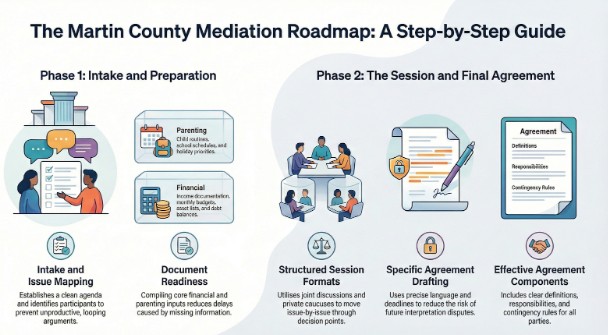
Martin County mediation follows a predictable sequence. Issue definition comes first. Document readiness comes next. Negotiation structure follows. Written agreement comes last.
The intake phase identifies participants, defines the decision list, and confirms readiness for mediation. A strong intake produces a clean agenda that prevents the session from becoming a looping argument.
Common intake outputs include.
Preparation predicts mediation productivity because preparation reduces missing-information delays. Martin County mediations often move faster when both parties bring the same core inputs.
Parenting inputs typically include.
Financial inputs typically include.
A mediation session starts with ground rules and a clear agenda, then the mediator moves issue by issue through decision points.
Many mediations use a mix of formats based on the level of conflict and communication needs.
A strong mediation agreement uses specific language that reduces the risk of later interpretation disputes. The final stage confirms terms, identifies open items, and clarifies procedural next steps.
A strong agreement typically includes.
Ann M. Goade, Esq., helps you prepare for a productive session with the right documents and a clear issue list. Book a mediation date today.
If you’re ready to get started, call us now!
Durable mediation outcomes use operational language, not emotional language. Agreements with dates, rules, and decision paths usually survive real-world stress.
Parenting plan stability comes from specificity.
Financial agreements hold when they use complete disclosure and clear execution steps. A structured approach to divorce financial mediation helps parties organize income, expenses, assets, and debts before negotiating final terms.
Property division requires both allocation and execution steps. Allocation answers who receives assets and debts. Execution defines transfers, timing, and documentation. A clear marital property inventory reduces disputes because both parties negotiate from the same asset and debt list.
Pro se mediation in Martin County helps self-represented parties negotiate a complete written agreement in a structured setting without either party controlling the process.
Pro se mediation works best when both parties can exchange information in good faith and commit to written terms covering parenting, support, and property decisions.
Pro se mediation works best when both parties can do three things.
A practical overview of pro se divorce in Florida helps self-represented parties understand common decision points and procedural expectations.
Bring documents that support decisions during the session so the session can produce complete written terms. Strong preparation reduces follow-up delays and reduces uncertainty during negotiation.
Complete information supports durable agreements because Florida family cases often rely on mandatory disclosure to ensure both parties negotiate from the same baseline facts.
Scheduling mediation starts with confirming the parties, the issue scope, and the preparation requirements for a productive session.
A clean intake, along with a documented plan, usually produces faster sessions and clearer written outcomes.
Virtual sessions work well when distance, schedules, or conflict make in-person meetings harder. A clear guide to virtual divorce mediation in Florida explains what parties should expect.
Ann M. Goade, Esq., provides a neutral, structured mediation process for divorce, timesharing, and support decisions. Request an intake now. Choose Ann M. Goade, Esq.
Florida law generally treats mediation communications as confidential, with limited statutory exceptions. Confidentiality supports candid settlement discussions because mediation is designed to resolve disputes rather than build a trial record.
A mediation agreement can become legally binding when the parties sign written terms that meet the legal requirements for the case type and the filing context. Enforceability depends on the document’s language and procedures, so many parties seek independent legal advice before signing.
Mediation length depends on the number of issues, document readiness, and the level of conflict. Parenting-only mediations often resolve faster than combined parenting and property mediations. A complete agenda and complete financial inputs usually reduce session time because parties can make decisions without pausing to gather missing information.
Many parties address both parenting and finances in a single mediation when both arrive prepared and ready to make decisions. Some cases resolve faster in phases because parenting decisions and financial decisions require different documents and different pacing.
Yes. Pro se parties can mediate when both parties are willing to negotiate and exchange information in good faith. A mediator can structure the session, manage communication, and translate agreements into written terms, but a mediator does not give legal advice.
Partial agreement still reduces conflict and still reduces court workload. Mediation can produce a written parenting agreement while identifying financial issues that require more disclosure, valuation, or time. Many parties first stabilize the parenting plan, then return to mediation with complete financial documentation.
Ask questions that reduce uncertainty and improve preparation. Ask what issues mediation can cover, what documents you should bring, whether online mediation is available, and how agreement drafting works. A list of questions to ask a marriage mediator in Florida helps parties prepare for an intake conversation.
Some Florida case paths can reduce or avoid in-person appearances based on case type, local procedure, and paperwork completeness. Parties should confirm requirements based on the specific filing situation.
Preparation improves outcomes by reducing uncertainty during negotiations. Parties usually benefit from complete financial inputs, a short issue list, and a primary proposal plus a fallback proposal for each major topic.
Florida divorce mediation typically follows a sequence from intake to preparation to structured negotiation to written agreement. A clear issue list and complete documents usually shorten the timeline.


Proudly Serving Areas
Navigation
Practice Areas
Contact Us