

We now offer Virtual Mediations using Enhanced Video Conferencing
Originally published: February 2026
By Ann M. Goade, Esq., Florida Supreme Court Certified Family Mediator and Family Law Attorney

Florida divorce mediation is a confidential, guided negotiation process in which a neutral mediator helps spouses resolve parenting, spousal support, and property issues without a trial.
The goal is a clear, enforceable agreement that saves time, lowers legal costs, and reduces conflict while keeping decision-making in the hands of the people affected.
If you understand how mediation works, you could save significant time and money. The process uses structured sessions in which a trained mediator helps you discuss everything from parenting plans to finances.
Mediation isn’t for everyone, but it’s often less hostile and more efficient for many couples in Florida. Some people swear by it, while others know right away it won’t fit their situation.
This guide walks you through the full mediation process in Florida. You’ll see what happens during sessions, how to prep your finances, when mediation just doesn’t make sense, and what to do if talks fall apart.

Florida divorce mediation is a confidential, voluntary process where a neutral mediator helps spouses negotiate parenting, support, and property terms.
The mediator facilitates discussion and drafts settlement language, but does not decide outcomes or provide legal advice. Final decisions stay with the parties, not the mediator or a judge.
| Process | Best For | Typical Tradeoff |
| Mediation | Couples who want privacy, control, and faster resolution | Requires good-faith negotiation and full financial disclosure |
| Litigation | Safety concerns, noncooperation, or urgent court orders | Higher cost, longer timeline, less personal control |
| Collaborative Divorce | Team-based, structured settlement support | It can be costly. All parties must commit to settling without court. |
A divorce mediator keeps discussions moving between you and your spouse, steering you toward agreements on the tough stuff.
They create a structured forum where both parties can address concerns regarding property, custody, alimony, and support.
Your mediator points out where you agree and where you don’t. They keep things productive and focused, offer options for resolving disputes, and help you see the real-world impact of each choice.
Mediators are trained to:
In Florida, many divorce cases settle without a trial, and mediation is often a key step that helps parties narrow issues or reach a full agreement. Your mediator serves as a communication bridge, especially when you and your spouse can’t talk directly.
Your Florida divorce mediator can’t make decisions for you or your spouse. Unlike a judge, the mediator doesn’t have the authority to impose a settlement or decide what’s fair.
A mediator is prohibited from:
The mediator won’t tell you if an agreement is legally solid or in your best interest. You’re responsible for your choices. If you need legal advice, you’ll have to talk to your own attorney.
Your mediator also can’t force your spouse to be honest or play fair. Mediation in Florida works best when both parties attend in good faith. If one person refuses to participate, the mediator can’t really do much about it.
If you’re ready to get started, call us now!

Mediation can occur early in the case, mid-case, or just before trial in a Florida divorce. Many couples use it to resolve parenting plans or financial disputes after exchanging information.
Successful mediation often shortens the case by narrowing issues, reducing hearings, and moving the parties toward a signed settlement.
In Florida, mediation often occurs after both sides have completed financial disclosures and discovery. You’ll exchange information on income, assets, debts, and expenses before meeting the mediator.
Is mediation mandatory in Florida? That depends on your county and your case. Many counties require it before a contested divorce can go to trial.
Your judge might order mediation at a case management conference or a pretrial hearing.
You might go to mediation at a few different points:
Mediation timing varies by circuit and judge, and once the court enters an order referring the case to mediation, the mediation is typically scheduled within the timeframe set by that order.
This gives you a window to settle and get paperwork drafted before your hearing. If mediation doesn’t work, your case moves to trial as scheduled.
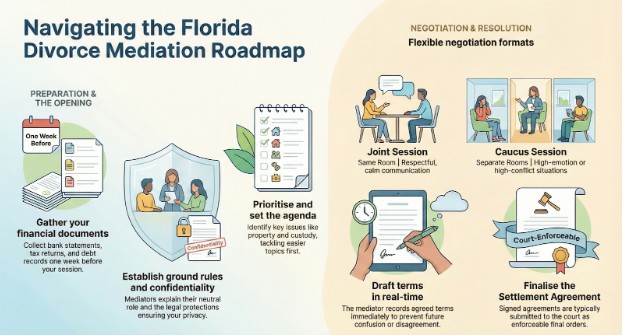
A typical mediation session follows a well-defined routine that begins weeks in advance and concludes with signed agreements or another session scheduled.
The mediator keeps the process moving and ensures both sides have equal time to speak and negotiate.
During the week before your first mediation session, you’ll need to gather financial documents. Think bank statements, tax returns, property deeds, retirement accounts, and debt records.
Some mediators request intake forms or summaries before the session, and court programs may require certain financial paperwork, but requirements vary by mediator and county.
These forms ask about assets, income, expenses, and the issue you want resolved. Complete them as fully and honestly as possible.
Jot down your priorities and what you’re willing to compromise on. Consider childcare schedules if you have kids, how you want to split property, and what kind of financial support seems fair.
Bring copies for everyone—yourself, your spouse, and the mediator.
Some mediators want a quick pre-mediation call to explain the process and answer questions. It’s not a bad idea, honestly—it can calm nerves before the big day.
The mediator starts by explaining the ground rules and their neutral role. You’ll hear that the mediator can’t give legal advice or force you to agree to anything.
Mediation communications are generally confidential under Florida law, with specific statutory exceptions, and mediators typically review confidentiality rules at the start of the session. This protection encourages honest communication without fear of legal repercussions.
The mediator asks each person to describe the main issues they want to talk about. Usually, it’s stuff like:
The mediator makes a written agenda based on your priorities. Typically, you’ll tackle the easiest issues first to build some momentum.
The Florida divorce mediation process uses two primary negotiation styles, depending on the situation and participants’ emotions.
Joint sessions keep both people in the same room with the mediator. This works if you can talk calmly and respectfully. The mediator guides the conversation and clears up misunderstandings.
Caucus sessions separate you into different rooms. The mediator goes back and forth, sharing offers and explaining each side’s position. This helps keep arguments at bay when emotions are running high or there’s a rocky history.
Most mediation sessions switch between joint and caucus formats. The mediator decides what is best for each topic as the process progresses.
When you agree on something, the mediator records the exact terms immediately. That way, nobody forgets or gets confused later.
The mediator drafts a Mediation Settlement Agreement for every decision you make together. It spells out numbers, dates, and responsibilities for each person. Read it carefully before you sign—don’t just rush through it.
Both people sign the agreement at the end of a successful session. A signed mediated settlement is often enforceable and, in divorce cases, is typically submitted to the court and incorporated into the final judgment or orders, especially when children are involved. If you brought your attorney, they’ll look over the terms before you sign anything.
Partial agreements are common when divorce mediation doesn’t resolve everything in one shot.
The mediator documents your agreement and schedules a subsequent session for the remainder. If you can’t settle the remaining issues, a judge might have to decide.
If you’re ready to get started, call us now!
Total mediation cost varies widely. Many straightforward cases may land in the low thousands, while complex parenting or financial disputes can cost more depending on hours, sessions, and drafting time.
That’s way less than the $15,000 to $40,000 per person you could spend on a contested divorce with attorneys. Knowing how mediators charge and what affects those costs helps you budget smarter.
| Input | Example |
| Mediator hourly rate | $300 per hour |
| Session length | 3 hours |
| Number of sessions | 2 |
| Drafting and follow-up time | 2 hours |
| Estimated total hours | 8 hours |
| Estimated total cost | $2,400 |
| Estimated cost per spouse (50/50) | $1,200 |
Most divorce mediators in Florida charge by the hour. Hourly rates typically range from $200 to $500, and you and your spouse usually split the cost equally.
Some mediators offer flat-fee packages for straightforward divorces. These packages might cover a set number of sessions or specific services, such as drafting your settlement agreement.
Flat fees provide predictable costs upfront, but they only work well if your case remains simple. If things get complicated, you’ll probably end up paying extra anyway.
Some cases resolve in one session, while others require multiple sessions. The number depends on how many issues are contested and on the completeness of financial information.
Complex cases may require more sessions, increasing your total cost.
The complexity of your situation affects your final bill more than anything else. If you own multiple properties, run a business together, or have complex retirement accounts, you’ll need more time in mediation to work through the details.
How prepared you are also matters. Entering mediation with organized financial documents and a clear understanding of your assets can speed up the process.
When you show up unprepared, the mediator spends billable time helping you gather basic information. Your ability to communicate and compromise directly impacts how many sessions you need.
Couples who can discuss issues calmly typically finish faster than those who argue over every detail. Mediation resolves 60-70% of cases without going to court, keeping costs manageable for most parties. Parenting Plan Mediation In Florida. Timesharing, Decision-Making, And Holidays
Mediation gives you the chance to build a detailed parenting schedule that covers daily routines, who makes important choices about your children, and how you’ll handle holidays and vacations.
Creating a parenting plan through mediation lets you design rules that fit your family, rather than having a judge decide for you.
| Topic | What to Specify |
| Exchanges | Pickup and drop-off time, location, who drives, and late policy |
| Holidays | Rotation, start and end times, travel notice requirements |
| Communication | Method, response time, and emergency contact rules |
| Decision-Making | Education, medical, and extracurricular approvals |
| Travel | Out-of-state notice, passports, and itinerary sharing |
| Disputes | Return to mediation, coordinator, court escalation steps |
Your time-sharing schedule sets exactly when your children stay with each parent. You need to spell out weekday nights, weekends, school breaks, and summer vacation in clear terms.
A good schedule includes pickup and drop-off times, locations, and the person or company responsible for transportation. Many parents choose alternating weeks, a 2-2-3 pattern, or weekdays with one parent and weekends split between the two.
The pattern matters less than choosing one that fits your work schedules and your children’s activities. Parenting plans must include specific details about transitions between homes.
You should address what happens when a parent is running late, how you’ll notify each other of schedule changes, and whether you need to meet at a neutral location or can handle pickups at each other’s homes.
Parental responsibility covers who makes major decisions about healthcare, education, and religious upbringing. You can share these choices equally or split them by category.
Your plan should explain how you’ll communicate about your children. Most parents use text, email, or co-parenting apps.
You need rules about response times for urgent versus routine matters. Include how you’ll handle disagreements about schooling, medical treatments, or extracurricular activities.
Some parents agree to use a tie-breaker method or return to mediation before going to court. Not everyone loves that idea, but it can save a lot of headaches later.
Your parenting plan needs a separate holiday schedule that overrides your regular time-sharing pattern.
List specific holidays such as Thanksgiving, Christmas Eve, Christmas Day, New Year’s, Easter, July 4th, and each parent’s birthday.
You can alternate holidays each year or split them between the parents, depending on family traditions. Spring break and winter break need their own schedules, too.
Travel rules protect both parents. You should require advance notice before taking children out of state, set rules about passport possession, and explain how you’ll share travel itineraries and contact information.
Divorce mediation addresses two main financial areas: dividing what you own and what you owe, and determining whether either spouse will pay support.
These negotiations often involve trade-offs between property and ongoing payments. It’s all about finding balance, even if that’s easier said than done.
Florida follows equitable distribution rules, meaning your marital property is divided fairly, not necessarily equally. During mediation, you’ll work through everything acquired during your marriage.
This includes your house, cars, bank accounts, retirement funds, and business interests. You’ll also divide marital debts, such as mortgages, credit cards, and loans.
The mediator helps you list all assets and debts, then guides discussions on how to split them.
Common marital assets:
Typical marital debts:
You can negotiate any division that works for both of you. Some couples split everything 50/50, while others create unequal divisions based on income, earning capacity, or the amount each contributed financially.
Alimony and child support are key topics in financial mediation. Child support calculations in Florida follow state guidelines based on both parents’ incomes and the number of children.
The mediator will help you review income documentation and calculate the guideline amount. You can agree to the guideline figure or negotiate a different amount if both of you consent.
Spousal support is more flexible. You’ll discuss factors such as the length of the marriage, each spouse’s income and earning capacity, the standard of living during the marriage, and financial needs.
Alimony can be temporary, bridge-the-gap, rehabilitative, or permanent, depending on your situation.
Key support factors:
Most couples make trade-offs to reach an agreement during mediation sessions. These exchanges help both parties feel the final deal is fair.
One spouse might keep the house in exchange for assuming the mortgage and relinquishing retirement accounts. Another common trade involves accepting less alimony in return for a larger share of assets.
You might also negotiate lower support payments if you receive more property upfront.
Popular trade-off scenarios:
The mediator helps you explore different combinations until you find terms both of you can accept. Your attorney can advise you on whether a proposed trade-off makes financial sense in your situation.
If parenting time, support, or property division feels stuck, mediation can quickly create momentum. Book a session with Ann Goade to work toward a durable, enforceable agreement.
If you’re ready to get started, call us now!
Financial dishonesty during divorce mediation can undermine fair settlement negotiations.
Recognizing warning signs early and taking specific legal actions helps protect your interests when a spouse may be concealing money or property.
Certain financial behaviors may indicate your spouse is hiding assets or income. Sudden changes in spending patterns or account balances warrant closer attention.
Watch for a reported income that is unexpectedly lower than your family’s previous lifestyle. If your spouse claims they can’t afford support payments but continues luxury purchases, this signals a problem.
Missing financial documents or reluctance to share tax returns and bank statements are common red flags.
Your spouse may also transfer money to friends or family members for “safekeeping” until the divorce is finalized.
New business partnerships or delayed bonuses that conveniently occur during divorce proceedings deserve scrutiny. Some spouses overpay taxes deliberately to receive refunds after the settlement.
Cryptocurrency purchases and offshore accounts represent increasingly common hiding places. You should also question significant cash withdrawals without clear explanations.
Florida law requires both spouses to provide full financial disclosure during divorce. You have legal tools to uncover concealed assets.
Hire a forensic accountant who specializes in uncovering hidden income and assets through detailed financial analysis.
These professionals examine tax returns, business records, and bank statements for inconsistencies.
Request complete documentation through formal discovery. Your attorney can issue subpoenas to banks, employers, and other institutions to obtain records your spouse won’t voluntarily share.
Florida courts impose serious consequences when they find intentional asset concealment.
The judge may award you a larger share of marital property, order your spouse to pay your attorney’s fees, or hold them in contempt of court.
Document everything you observe and share your concerns with your divorce attorney immediately. Early action prevents assets from disappearing and strengthens your position in mediation.
Mediation requires both parties to negotiate in good faith, but domestic violence and coercive control create power imbalances that make fair negotiation impossible.
Florida law recognizes these dangers and provides alternatives when your safety is at risk.
If you have concerns about abuse but court-ordered mediation is still required, Florida mediators can implement specific safety measures.
Specialized mediators trained in domestic and family violence can arrange separate arrival and departure times for you and your spouse.
Shuttle mediation allows you to remain in separate rooms while the mediator circulates proposals. You never have to sit face-to-face with an abusive partner.
Virtual mediation via video conferencing provides another layer of protection, allowing you to participate from a safe location. You can bring a support person of your choice to attend mediation sessions with you.
This person can provide emotional support and help you maintain boundaries during negotiations. Some mediators also allow attorneys to remain present throughout the session in domestic violence cases.
Common safety adaptations include:
Coercive control covers emotional, psychological, sexual, physical, and economic abuse. It also includes threats, intimidation, and stalking. These patterns make mediation risky because the abuser can still control you, even in a so-called neutral setting.
If your spouse has hurt you or your kids, you should ask for a court hearing instead of mediation.
Active restraining orders, recent police reports, or documented threats are all strong signs that mediation just isn’t safe. Courts sometimes call these “high-conflict” cases, when in reality they require immediate assistance from a judge.
If there is a history of domestic violence that would compromise mediation, the court can limit or waive mediation requirements and may use safety-focused procedures when mediation proceeds.
You can file a motion to skip mediation by showing police reports, medical records, or witness statements. Judges can waive mediation if your safety is at risk.
If you walk into mediation without a plan, you’re setting yourself up to lose ground. You need your numbers, your boundaries, and a way to stay calm when things get tense.
Create a single-page sheet listing your ideal outcome, your acceptable compromise, and your walk-away point. This one-pager helps you stay on track when talks get messy.
Write down your top three priorities in order. Most people prioritize child custody, the family home, and retirement accounts. For each, jot down what you want and what you’ll accept at minimum.
Use real numbers and percentages. Instead of saying “fair division of assets,” write “60% of the marital home equity, which is $180,000 if the equity is $300,000.” Your attorney at mediation can review this sheet to ensure your goals align with Florida law.
Add your non-negotiables. Maybe it’s primary custody or keeping your business—whatever you absolutely won’t budge on. Having these written down keeps you from caving in the heat of the moment.
Before mediation, you need to know your minimum acceptable settlement, your target settlement, and your BATNA (best alternative to a negotiated agreement). These three numbers guide your choices.
Your minimum is the lowest you’ll accept before you walk away. Figure this out by thinking about what you’d get at trial, minus legal fees and the time it’ll take.
Your target settlement is your realistic goal under Florida’s equitable distribution laws. This number lies between your ideal and your minimum.
Your BATNA is your backup plan if mediation fails. Usually, that means more litigation, higher attorney fees (typically $5,000 to $15,000 or more), and months of additional stress. Knowing this cost helps you decide if a settlement really makes sense.
Mediation can stir up big emotions, and losing your cool can wreck your chances of a good outcome. When preparing for mediation, you need tools to manage your emotional responses.
Figure out your triggers before you walk in. Maybe it’s seeing your spouse, certain topics like cheating, or feeling rushed to decide. Plan how you’ll handle these moments.
Try the “pause and caucus” trick. If you’re overwhelmed, ask the mediator for a private break with your attorney. Use that time to regroup and breathe.
Practice the 4-7-8 breathing technique: breathe in for 4 seconds, hold for 7 seconds, and exhale for 8 seconds. It calms your system and helps you think rather than just react.
When you reach a mediation agreement, the mediator writes up a formal document with all the terms you and your spouse agreed on. The court still needs to approve this agreement before your divorce is final.
The mediator drafts a settlement agreement with everything you and your spouse agreed on. This covers property division, debts, custody, visitation, child support, and alimony if needed.
Your mediated settlement agreement becomes legally binding once both of you sign and the court approves it.
The agreement gets folded into your final divorce judgment. Review it carefully before signing—make sure it matches what you actually agreed to.
Key elements your agreement must include:
After you sign your marital settlement agreement, you need to submit it to the court along with the other required divorce paperwork. Usually, your attorney handles this filing and prepares the final judgment for the judge.
You may need to complete additional forms depending on your situation. Think about updating beneficiaries on life insurance, transferring property titles, refinancing a mortgage, or opening new bank accounts.
Some agreements require you to take parenting classes before the court finalizes your divorce.
The judge reviews your agreement to ensure it complies with Florida law and protects the kids’ best interests. If everything looks good, the judge signs off, and your divorce is official.
Sometimes mediation doesn’t end with a full agreement, but that doesn’t mean you wasted your time. Even if mediation fails to settle everything, you still have ways to move forward with your divorce.
You might settle some issues even if you can’t agree on all of them. Maybe you both agree on child custody, but can’t see eye to eye on alimony. Or you divide property, but need a judge to decide spousal support.
Court accepts partial settlements. You’ll go to trial only for the unresolved issues, which saves time and money since you don’t have to fight over everything.
Your partial agreement gets documented and added to your final divorce decree. The judge reviews it to make sure it’s fair and legal. You’ll only need to present evidence about the issues you still can’t agree on at trial.
If settlements don’t happen during mediation, you’ve still got a few ways to move forward.
You can try mediation again with a different mediator. Sometimes, a fresh perspective or approach makes a big difference.
Another route is attorney-managed negotiation outside the formal setting. Your lawyers just keep talking, and sometimes they work things out without a mediator in the room.
And then there’s trial. A judge listens to both sides and decides on whatever you couldn’t settle.
This route costs the most and takes the longest, but sometimes you just can’t avoid it.
Ann Goade runs mediation with structure, calm momentum, and plain-language clarity. The goal is not a “perfect” conversation. The goal is a workable agreement you can live with, and one specific enough to be enforceable.
People who want to protect their time, reduce stress, and keep control of outcomes. Especially parents who need a parenting plan that minimizes future disputes.
Schedule a confidential Florida divorce mediation consultation with Ann Goade to clarify your goals, identify sticking points, and map the fastest path to a clear, enforceable settlement.
Is Divorce Mediation Mandatory in Florida?
Often, yes, for contested cases, but there is no single statewide rule. Many circuits and judges order mediation before a contested final hearing or trial. Your court’s referral order controls timing, attendance, and deadlines.
How Much Does Divorce Mediation Cost in Florida?
The cost of Florida divorce mediation varies by mediator and county. Private mediators typically charge by the hour, and court programs may use income-based set fees. The total cost depends mainly on the hourly rate, preparation, the number of sessions, and drafting time.
How Long Does Florida Divorce Mediation Take?
Some couples settle in one session; others require multiple sessions over several weeks. Timing depends on how many issues are contested, whether financial disclosure is complete, and how prepared both spouses are with documents, proposals, and priorities.
Is Florida Divorce Mediation Confidential?
In Florida, mediation communications are generally confidential, with statutory exceptions. Mediators typically review confidentiality at the start. What you say in mediation is usually protected, but the final written settlement filed with the court is not automatically private.
Do I Need a Lawyer for Divorce Mediation in Florida?
You can mediate with or without attorneys. Many court programs allow parties to attend without lawyers, and some couples choose attorney-attended mediation for legal guidance. Whether counsel attends is a strategy choice, not an automatic requirement.
What Should I Bring to Florida Divorce Mediation?
Bring recent pay stubs, tax returns, bank statements, retirement statements, debt balances, and a list of monthly expenses. If you have children, bring proposed timesharing schedules, holiday ideas, and key concerns. Also, bring your top priorities and nonnegotiables.
What Happens If We Do Not Reach an Agreement in Mediation?
If you do not settle, your case will proceed to court. You can schedule another mediation, negotiate through attorneys, or settle some issues and leave the rest for a judge. Partial agreements can still reduce the number of hearings and trial time.


Proudly Serving Areas
Navigation
Practice Areas
Contact Us