

We now offer Virtual Mediations using Enhanced Video Conferencing
Originally published: May 2026 | Updated: September 2026
By Ann M. Goade, Esq., Florida Supreme Court Certified Family Mediator and Family Law Attorney
The ACR Advanced Practitioner designation in Family and Divorce Mediation is a peer-reviewed credential awarded by the Association for Conflict Resolution to family mediators who have completed 250 face-to-face mediation hours, 25 completed cases, 60 hours of family mediation training, and 4 hours of supervised case consultation — with 20 hours of continuing education every two years.
Ann M. Goade, Esq. earned the designation in 2006 and is the only ACR Advanced Practitioner serving the Treasure Coast and Palm Beach market.
The Association for Conflict Resolution (ACR) is an international professional organization dedicated to enhancing the practice and public understanding of conflict resolution across mediation, arbitration, and dispute resolution fields.
ACR sets voluntary professional standards for mediators that go beyond the minimum licensing or court-certification requirements imposed by individual states.
ACR’s Family Section governs the Advanced Practitioner designation for family and divorce mediators — establishing the training, experience, consultation, and continuing education requirements mediators must meet before peer review grants the designation.
If you’re ready to get started, call us now!
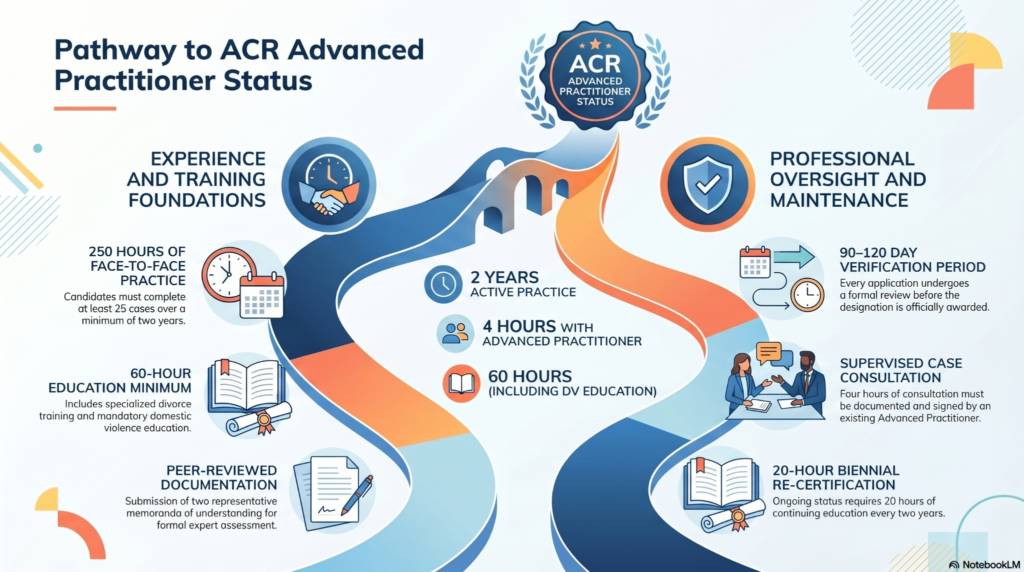
ACR Advanced Practitioner status in Family and Divorce Mediation requires all of the following, verified by peer review per the ACR Advanced Practitioner Guidelines:
ACR processes every application over 90 to 120 days before reaching a designation decision — so the designation is not self-reported or automatically awarded upon meeting the minimums.
Florida Supreme Court certification and ACR Advanced Practitioner status measure different things — and understanding the difference tells a Treasure Coast family what they are actually getting when they hire a mediator who holds both.
| Credential | Issuing Body | What It Measures | Required For |
| Florida Supreme Court Certified Family Mediator | Florida Dispute Resolution Center | Minimum training, background check, points-based qualification | Court-referred family mediation in Florida |
| ACR Advanced Practitioner — Family Law | Association for Conflict Resolution | Verified case experience, peer-reviewed training, supervised consultation, and ongoing education | Voluntary — no court requires it |
Florida Supreme Court certification is the legal minimum a mediator must hold to conduct court-referred family cases in Florida.
ACR Advanced Practitioner status requires verified case hours, peer-reviewed documentation, and supervised consultation with an existing Advanced Practitioner — awarded above and beyond the state minimum requirement.
A Florida Supreme Court-certified mediator has met the state’s minimum requirements. An ACR Advanced Practitioner has also demonstrated sustained, peer-verified expertise in family mediation cases specifically, so Treasure Coast families comparing mediators have a concrete, externally verified data point beyond the minimum state credential.
If you’re ready to get started, call us now!
Treasure Coast families choosing a family mediator face a market where most practitioners list Florida Supreme Court certification as their primary credential — because Florida law requires it, and it is the most recognizable credential in the local market.
ACR Advanced Practitioner status adds a layer of peer-verified expertise that Florida Supreme Court certification neither requires nor measures.
Families in Martin County, Palm Beach County, St. Lucie County, and Indian River County benefit from the following verified differences the ACR Advanced Practitioner designation produces:
Ann Goade earned ACR Advanced Practitioner status in Family Law in 2006, after more than a decade of Florida Supreme Court Certified family mediation practice on the Treasure Coast.
Families reviewing mediators in Stuart, Port St. Lucie, West Palm Beach, Jupiter, and Vero Beach will not find another mediator in this market holding the same combination of Florida Supreme Court certification since 1993 and ACR Advanced Practitioner status since 2006.
For a Treasure Coast family sitting across a mediation table, the ACR Advanced Practitioner designation translates into concrete differences in session quality across three practice areas:
The about page documents the full credential history — Florida Supreme Court certification since 1993, ACR Advanced Practitioner status since 2006, AV Preeminent peer-review rating from Martindale-Hubbell, and multi-state bar admission across Florida, Illinois, Missouri, and Tennessee.
Your family dispute deserves more than the minimum state credential. Start mediation with Ann Goade today — call (772) 288-7275 or email info@anngoade.com.
What is the ACR Advanced Practitioner designation in family mediation?
The ACR Advanced Practitioner designation is a peer-reviewed credential awarded by the Association for Conflict Resolution to family mediators who have completed at least 250 face-to-face mediation hours, 60 training hours, 25 completed cases, and 4 hours of supervised case consultation with an existing Advanced Practitioner member.
How does the ACR Advanced Practitioner status differ from the Florida Supreme Court certification?
Florida Supreme Court certification is the minimum legal requirement for conducting court-referred family mediation in Florida. ACR Advanced Practitioner status is a voluntary peer-reviewed credential requiring verified case hours, submitted work samples, supervised consultation, and ongoing continuing education — awarded above and beyond the state minimum.
When did Ann Goade earn the ACR Advanced Practitioner designation?
Ann Goade earned the ACR Advanced Practitioner designation in Family Law in 2006, after more than a decade of active Florida Supreme Court Certified family mediation practice on the Treasure Coast. She has held Florida Supreme Court certification since 1993 and the ACR Advanced Practitioner designation since 2006.
How many mediators in the Treasure Coast and Palm Beach market hold ACR Advanced Practitioner status?
Ann Goade is the only mediator serving the Treasure Coast and Palm Beach County market who holds ACR Advanced Practitioner status in family mediation as of 2026. Competing mediators in Martin, St. Lucie, Indian River, and Palm Beach counties hold Florida Supreme Court certification but not the designation.
Does ACR Advanced Practitioner status require ongoing education?
ACR Advanced Practitioner status requires 20 hours of continuing mediation education every two years to maintain the designation. Qualifying education includes attendance at the ACR Annual Conference, participation in Section meetings, consultation with other Advanced Practitioner members, and other approved continuing mediation education programs.
What is the ACR Family Section?
The ACR Family Section is the division of the Association for Conflict Resolution that governs standards, training requirements, and the Advanced Practitioner designation for family and divorce mediators. The Family Section establishes the peer-review process through which mediators apply for and maintain Advanced Practitioner status in family mediation.
Does ACR Advanced Practitioner status expire or require renewal?
ACR Advanced Practitioner status requires renewal through ongoing continuing education — mediators must complete 20 hours of qualifying education every two years to maintain the designation. Failure to meet the continuing education requirement results in loss of Advanced Practitioner status under ACR Family Section guidelines.
How can a family verify that their mediator holds ACR Advanced Practitioner status?
Families verify ACR Advanced Practitioner status by contacting the Association for Conflict Resolution directly at membership@acrnet.org or by requesting documentation from the mediator. Ann Goade earned the ACR Advanced Practitioner designation in Family Law in 2006 and maintains the designation through the required ongoing mediation education.


Proudly Serving Areas
Navigation
Practice Areas
Contact Us