

We now offer Virtual Mediations using Enhanced Video Conferencing
Originally published: August 2026
By Ann M. Goade, Esq., Florida Supreme Court Certified Family Mediator and Family Law Attorney

A Florida mediation that resolves some issues but not all is not automatically a failed mediation — it is a partial agreement, and Florida procedure gives that outcome its own defined path.
Florida Family Law Rule of Procedure 12.740(f)(1) provides that if agreement is reached “as to any matter or issue,” it must be reduced to writing, signed, and submitted to the court unless the parties agree otherwise — language that does not require every issue in the case to settle first.
Whatever remains open proceeds separately, narrowing what still needs to be decided rather than restarting the case.
A mediation session that resolves most issues is not a failed session. Ann M. Goade helps Florida families finish what mediation started. Schedule a consultation.
Success in Florida family mediation is not defined by Florida procedure as an all-or-nothing outcome.
Florida Family Law Rule of Procedure 12.740(f)(1) applies whenever agreement is reached “as to any matter or issue” — wording that accommodates resolving one issue, several issues, or all of them, rather than requiring complete resolution before the writing-and-signature requirement applies.
From a practicing mediator’s perspective, a session that resolves the parenting schedule and child support but leaves property division open has still removed two contested issues from the case.
Ann M. Goade, Esq., a Florida Supreme Court-certified family and dependency mediator based in Palm City, Florida, who has limited her legal career to family law mediation since 1993, treats that kind of partial outcome as meaningful progress rather than an incomplete result, since each resolved issue is one the spouses no longer need a judge to decide.
A partial agreement follows the same writing-and-signature requirement as a full settlement, just for a narrower set of issues.
Subsection (f)(1) requires that once an agreement is reached, it be reduced to writing, signed by the parties and their counsel if present, and submitted to the court unless the parties agree otherwise.
Subsection (f)(2) then addresses when that filed agreement takes legal effect: the agreement becomes binding upon filing when court approval is not necessary, or upon court approval when approval is required.
Practically, this means spouses who agree during the mediation process on parenting time but not alimony can sign a written agreement covering parenting time alone.
That signed document is submitted for the resolved issue, and its binding effect follows the filing-or-approval rule above, while alimony continues as an open matter on a separate track.
If you’re ready to get started, call us now!
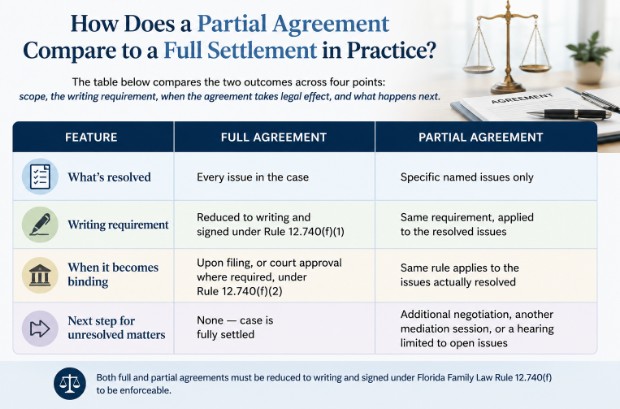
The table below compares the two outcomes across four points: scope, the writing requirement, when the agreement takes legal effect, and what happens next.
| Feature | Full Agreement | Partial Agreement |
| What’s resolved | Every issue in the case | Specific named issues only |
| Writing requirement | Reduced to writing and signed under Rule 12.740(f)(1) | Same requirement, applied to the resolved issues |
| When it becomes binding | Upon filing, or court approval where required, under Rule 12.740(f)(2) | Same rule applies to the issues actually resolved |
| Next step for unresolved matters | None — case is fully settled | Additional negotiation, another mediation session, or a hearing limited to open issues |
The practical difference between the two outcomes is scope, not the underlying procedural framework.
A signed partial agreement follows the same writing, filing, and binding-effect rules as a full settlement for the issues it covers; what differs is how much of the case it addresses.
Clarity about which issues are resolved and which remain open is the detail most likely to get missed when a session ends in partial agreement.
A mediation checklist built around topic areas — property, parenting, support — helps confirm that each topic is explicitly marked as resolved or still open, rather than left ambiguous.
Property-related terms that reach a property division mediation agreement should be written with the same specificity as a full settlement covering that topic.
The same applies to time-sharing schedules, alimony terms, or child support figures reached during a session — each resolved issue benefits from the same level of written detail whether or not every other issue in the case settled that day.
If you’re ready to get started, call us now!
Unresolved issues after a partial agreement do not follow one single path in every case; the available next steps depend on the specific issues left open and how the parties want to proceed.
Common paths include continued direct negotiation between the spouses or their counsel, an additional mediation session focused only on the remaining issues, or, if agreement is not reached, a court hearing limited to the unresolved issues.
Nothing in Florida’s mediation rules limits parties to a single session, so returning to mediation for the remaining issues is a routine next step rather than an exception.
The table below outlines each path and what it typically involves.
| Path Forward | What It Involves |
| Continued negotiation | Spouses or counsel keep negotiating the remaining issues outside a formal session |
| Additional mediation session | A follow-up session focused specifically on the issues left open |
| Court hearing on remaining issues | A judge addresses the unresolved matters, since the resolved issues have already been submitted for filing or approval, though the exact scope of any hearing depends on the case |
Financial mediation sessions sometimes reach agreement on most financial terms while a single disputed asset—a business valuation, for example—remains open. Once the resolved terms are filed and, where required, approved under subsection (f)(2), those terms generally do not require renegotiation, and the specific open item is typically what needs further attention going forward.
Unresolved issues after mediation do not have to mean a court battle. Ann M. Goade helps narrow disputes to what remains contested. Request a session.
Whether a case still needs a hearing on certain issues is separate from whether the mediation succeeded in resolving the issues it did resolve.
A high-conflict parenting plan negotiation that settles the time-sharing schedule but leaves a decision-making dispute for the court still reduces what the hearing needs to cover, compared to a case where mediation resolves nothing.
Florida courts frequently require mandatory family mediation before a contested hearing. From a practical standpoint, even partial resolution in that mediation can narrow the number of issues a judge ultimately needs to decide at the hearing that follows.
Fewer contested issues generally mean less for a court to resolve at a later hearing, though the specific effect on cost and timeline depends on the complexity of what remains open and the particular court’s schedule.
A case where mediation resolved parenting and support, leaving only a single property question, presents a narrower hearing than one where every issue is still contested.
Ann Goade’s family law mediation practice approaches partial agreements as a way to move resolved issues toward filing right away, rather than holding every term open until the entire case settles.
More on her background is available on Ann M. Goade’s about page, reflecting more than three decades focused on family law mediation across Martin, St. Lucie, and Palm Beach counties.
What is a partial agreement in Florida divorce mediation?
A partial agreement is a written, signed resolution of some — but not all — issues in a Florida divorce or family law case reached during mediation. The resolved issues are submitted to the court under Rule 12.740(f) while the remaining issues continue toward further negotiation or a hearing.
Does a partial mediation agreement need to be in writing to count?
Yes. Florida Family Law Rule of Procedure 12.740(f)(1) requires any agreement reached on a matter or issue to be reduced to writing and signed by the parties before it is submitted to the court, unless the parties agree otherwise.
What happens to unresolved issues after a partial mediation agreement, and do they automatically go to trial?
Not automatically. Unresolved issues can proceed through continued negotiation, an additional mediation session, or, if no further agreement is reached, a court hearing limited to those specific matters. The applicable path depends on the issues involved and the parties’ choices.
Is a partial agreement legally binding for the issues it covers?
A partial agreement that is reduced to writing, signed, and filed becomes binding under Rule 12.740(f)(2) — upon filing when court approval isn’t necessary, or upon court approval when it is required — for the specific issues it addresses.
Does reaching only a partial agreement mean mediation failed?
No. Rule 12.740(f)(1) applies whenever agreement is reached on any matter or issue, not only when every issue in the case settles, meaning partial resolution fits within the rule’s own framework rather than falling outside it.
Can a partial agreement be changed before the divorce is finalized?
Terms in a signed partial agreement can potentially be revisited by mutual agreement before filing or court approval, though this depends on the specific issue, case posture, and whether the agreement has already become binding. A family law attorney can advise on a specific situation.
How does a mediator report a partial agreement to the court?
Rule 12.740(f)(1) requires an agreement reached on any matter or issue to be reduced to writing, signed, and submitted to the court unless the parties agree otherwise. Confirm the reporting process for any unresolved issues with the assigned mediator or the court for your case.
Does partial agreement save money compared to resolving nothing in mediation?
Resolving even some issues in mediation generally means less remains for attorneys and the court to address afterward, though the specific cost impact varies by case complexity and the issues still open after the session.
Partial resolution and full resolution follow the same procedural rules under Florida Family Law Rule of Procedure 12.740 — writing, signature, and a filing-or-approval standard for when terms take effect.
The difference between the two is simply how much of the case a given agreement covers. What’s left open moves forward on its own track, and each issue resolved along the way is one less thing standing between a family and a finished case.
A partial agreement is still progress, not a setback. Ann M. Goade helps Florida families move forward with what mediation resolved. Schedule a consultation.


Proudly Serving Areas
Navigation
Practice Areas
Contact Us