

We now offer Virtual Mediations using Enhanced Video Conferencing
Originally published: June 2026
By Ann M. Goade, Esq., Florida Supreme Court Certified Family Mediator and Family Law Attorney

Yes — mediation is mandatory in most contested Florida divorces before a judge will schedule a trial. Florida Family Law Rule 12.740 and Fla. Stat. § 61.183 require courts to refer contested family matters to a Florida Supreme Court-certified mediator.
Covered disputes include child custody, timesharing, child support, and property division.
In 2026, private family law mediation sessions cost $150–$400 per party per session, while a fully litigated divorce in Florida runs $15,000–$30,000 or more per spouse. Mediation settles 70–80% of cases without trial.
Facing a contested divorce in Palm Beach or Martin County and unsure whether mediation applies to your case? Ann M. Goade, Certified Family Law Mediator, helps couples resolve custody, support, and property disputes without trial — schedule a mediation session today.
Florida requires mediation in virtually every contested divorce before the case reaches trial. Under Florida Family Law Rule 12.740, courts must order mediation when spouses disagree on any issue — child custody, child support, alimony, or equitable distribution of marital assets.
Fla. Stat. § 61.183 specifically authorizes courts to order mediation of contested parental responsibility, timesharing, and support disputes.
The rule applies to circuits that maintain family mediation programs, which, in practice, means every judicial circuit in South Florida, including the Fifteenth Circuit (Palm Beach County) and the Nineteenth Circuit (Martin, St. Lucie, Indian River, and Okeechobee Counties).
The mediator must hold Florida Supreme Court certification in family mediation. This credential requires specialized training in family dynamics, child development, and domestic violence screening, in addition to general civil mediation certification.
Only narrow exceptions exist. Under Fla. Stat. § 44.102, a court shall not refer a case to mediation if it finds a history of domestic violence that would compromise the process. Courts may also waive mediation when parties cannot afford fees or when prior mediation attempts have failed.
Private divorce mediation in Florida costs $150–$400 per party per session in 2026, with most South Florida mediators charging $200–$350 per hour. A typical half-day session (three to four hours) runs $600–$1,400 total, split between both spouses.
Complete mediated divorces generally cost $3,000–$8,000 for both parties combined — a fraction of the $15,000–$30,000+ per spouse that fully litigated divorces cost.
Court-connected mediation programs offer lower, income-based fees. Households earning under $50,000 annually pay approximately $60 per person per session, while those earning $50,000–$100,000 pay around $120 per session.
Parties who qualify as indigent under Florida’s civil indigent status application receive court-connected mediation at no cost.
| Cost Factor | Mediation | Litigation |
| Per-party session cost | $150–$400 | N/A (billed hourly by attorney) |
| Total cost, both parties | $3,000–$8,000 | $30,000–$60,000+ combined |
| Typical duration | 2–4 months | 12–18 months |
| Court-connected option | $60–$120/session (income-based) | Not available |
| Settlement rate | 70–80% | Decided by a judge |
Three factors affect where a case falls within these ranges. Disputes limited to one or two issues — timesharing schedules or division of a single retirement account — often resolve in a single session.
Cases involving contested custody, business valuations, or high-asset estates typically require three to five sessions and push costs toward the higher end.
If you’re ready to get started, call us now!
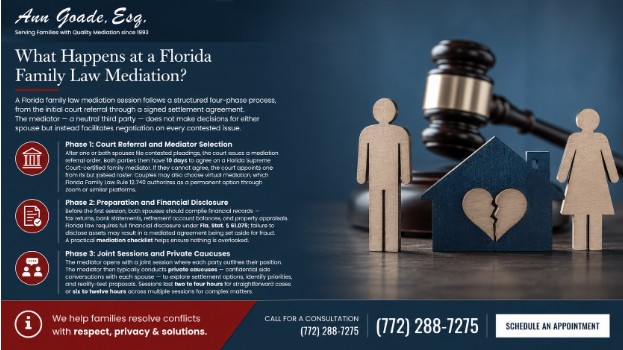
A Florida family law mediation session follows a structured four-phase process, from the initial court referral through a signed settlement agreement. The mediator — a neutral third party — does not make decisions for either spouse but instead facilitates negotiation on every contested issue.
After one or both spouses file contested pleadings, the court issues a mediation referral order. Both parties then have 10 days to agree on a Florida Supreme Court-certified family mediator.
If they cannot agree, the court appoints one from its approved roster. Couples may also choose virtual mediation, which Florida Family Law Rule 12.740 authorizes as a permanent option through Zoom or similar platforms.
Before the first session, both spouses should compile financial records — tax returns, bank statements, retirement account balances, and property appraisals.
Florida law requires full financial disclosure under Fla. Stat. § 61.075; failure to disclose assets may result in a mediated agreement being set aside for fraud. A practical mediation checklist helps ensure nothing is overlooked.
The mediator opens with a joint session where each party outlines their position. The mediator then typically conducts private caucuses — confidential side conversations with each spouse — to explore settlement options, identify priorities, and reality-test proposals.
Sessions last two to four hours for straightforward cases or six to twelve hours across multiple sessions for complex matters.
Both parties typically split mediation costs equally unless the court orders a different allocation. Judges may order one spouse to pay a larger share — or the full cost — when a significant income disparity exists between the parties.
The court considers each spouse’s financial resources, earning capacity, and overall ability to pay when deciding allocation.
In pro se divorces — where one or both spouses proceed without an attorney — mediation is still mandatory for contested issues, and the same cost-sharing rules apply.
Pro se parties who cannot afford a private mediator can request court-connected mediation at reduced fees or apply for indigent status to receive free mediation services.
When one party attempts to avoid mediation or refuses to participate in good faith, the court may impose sanctions, including requiring the uncooperative party to pay the full mediation cost and the opposing party’s attorney fees incurred in bringing a motion to compel.
Saving thousands on legal fees in a Palm Beach or Martin County divorce starts with choosing the right mediator. Ann Goade guides pro se and represented couples through efficient, cost-effective sessions — book your mediation.
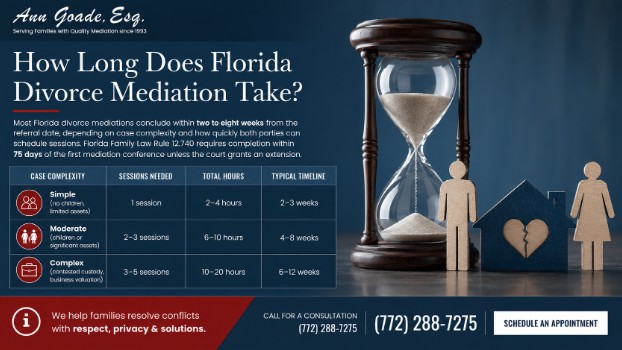
Most Florida divorce mediations conclude within two to eight weeks from the referral date, depending on case complexity and how quickly both parties can schedule sessions. Florida Family Law Rule 12.740 requires completion within 75 days of the first mediation conference unless the court grants an extension.
| Case Complexity | Sessions Needed | Total Hours | Typical Timeline |
| Simple (no children, limited assets) | 1 session | 2–4 hours | 2–3 weeks |
| Moderate (children or significant assets) | 2–3 sessions | 6–10 hours | 4–8 weeks |
| Complex (contested custody, business valuation) | 3–5 sessions | 10–20 hours | 6–12 weeks |
By comparison, a fully litigated divorce in Florida takes 12–18 months on average, with complex cases stretching beyond two years. Mediation’s compressed timeline reduces attorney fees, court costs, and the emotional strain of prolonged legal proceedings.
Once the parties sign a Mediated Settlement Agreement, the mediator files it with the court. Agreements that do not affect minor children become binding immediately upon filing.
Agreements involving children require judicial review under Florida’s best-interests standard before becoming final — typically adding two to four weeks for court approval.
If you’re ready to get started, call us now!
A Florida procedural law enacted in 2025 requires court reporters to transcribe or audio-record certain divorce proceedings where allegations of abuse or neglect arise. The requirement applies to courtroom proceedings — hearings, trials, and depositions — not to mediation sessions themselves.
Mediation remains confidential under Fla. Stat. § 44.405. Statements made during mediation cannot be disclosed in court, and no recording of mediation sessions is required or permitted without both parties’ consent.
The confidentiality of mediation is one of its core advantages — spouses can explore settlement options freely without worrying that admissions or proposals will be used against them later.
The recording requirement does, however, strengthen the procedural record in cases that fail to settle at mediation and proceed to trial.
If allegations of abuse surface during litigation, the transcribed record ensures an accurate account of courtroom testimony — a safeguard that protects both parties and helps judges make fully informed custody and safety decisions.
When mediation does not produce a full agreement, the case proceeds to trial on the unresolved issues. The mediator files a report with the court indicating whether the parties reached full agreement, partial agreement, or impasse — but the report discloses nothing about the substance of the discussions or any offers exchanged.
Mediation confidentiality, codified in Fla. Stat. § 44.405, means that positions taken during mediation cannot prejudice either party at trial.
Partial agreements remain valid and enforceable. If spouses resolve equitable distribution but cannot agree on timesharing, the property agreement stands, and only the custody dispute goes before the judge. Partial resolution narrows the scope of the trial, reducing attorney fees and the overall emotional burden.
Mediation resolves 70–80% of Florida family cases, according to statewide data from the Florida court system.
Even among the 20–30% who reach an impasse, most settle before trial, as the mediation process clarifies each party’s position and the likely range of judicial outcomes.
Is mediation required before a divorce trial in Florida?
Yes. Florida Family Law Rule 12.740 mandates mediation in contested divorces before trial. Courts must refer custody, timesharing, and support disputes to a Florida Supreme Court-certified family mediator. Exceptions exist for documented domestic violence, inability to pay fees, or prior failed mediation attempts.
How much does divorce mediation cost in Florida in 2026?
Private mediation costs $150–$400 per party per session in 2026, with total costs for both spouses typically ranging from $3,000 to $8,000. Court-connected mediation offers income-based fees ranging from $60 to $120 per session. Fully litigated divorces cost $15,000–$30,000 or more per spouse.
What is the difference between mediation and going to trial?
Mediation uses a neutral facilitator who helps spouses negotiate their own agreement. Trial places the decision in a judge’s hands after adversarial testimony. Mediation costs less, resolves faster — two to four months versus twelve to eighteen months — and produces agreements with higher compliance rates.
Can I bring my attorney to mediation in Florida?
Yes. Attorneys may attend mediation sessions and advise their clients, but each spouse must participate directly rather than communicating solely through counsel. Some pro se parties mediate without attorneys present and have a family law attorney review the agreement before signing.
What should I bring to a Florida divorce mediation session?
Bring recent tax returns, bank statements, retirement account statements, property appraisals, and a proposed parenting plan if children are involved. Florida law requires full financial disclosure under Fla. Stat. § 61.075. Organized records speed negotiation and help both parties evaluate proposals.
Are mediation discussions confidential in Florida?
Yes. Fla. Stat. § 44.405 protects all communications made during mediation from disclosure in subsequent court proceedings. Neither party can use statements, offers, or admissions from mediation as evidence at trial. Limited exceptions exist for criminal conduct and mediator misconduct.
What happens if my spouse refuses to participate in mediation?
A court can compel attendance at mediation and impose sanctions on a non-participating spouse. Sanctions may include paying the full mediation cost, covering the other party’s attorney fees for a motion to compel, and adverse inferences at trial. Florida courts enforce participation requirements strictly.
Can mediation address child custody and support together?
Yes. Florida family mediation covers all contested issues simultaneously, including parental responsibility, timesharing schedules, child support calculations, alimony, and property division. Addressing everything in a single process avoids the fragmentation and additional costs of litigating individual issues separately across multiple hearings.
Is a mediated agreement legally binding in Florida?
Yes. Under Florida Family Law Rule 12.740, a Mediated Settlement Agreement becomes legally binding when signed by both parties and, if present, their attorneys. The court incorporates the agreement into the final dissolution judgment. Agreements affecting children require judicial review under Florida’s best-interests standard.
How is Florida family mediation different from couples counseling?
Mediation is a legal negotiation process focused on reaching binding agreements on divorce-related issues — property division, custody, and support. Couples counseling is a therapeutic approach that aims to improve the relationship. A mediator does not provide therapy or legal advice — the role is strictly to facilitate agreement.
Can I mediate if there are domestic violence concerns?
Florida law exempts domestic violence cases from mandatory mediation. Under Fla. Stat. § 44.102, a court shall not refer a case to mediation when a history of domestic violence would compromise the process. Courts that order mediation despite concerns must implement safeguards— such as separate waiting areas, staggered arrivals, or virtual-only sessions.
Does Florida offer free or low-cost mediation?
Yes. Court-connected mediation programs charge income-based fees, and parties who qualify as indigent receive mediation at no cost. Households earning less than $50,000 pay approximately $60 per person per session. Some judicial circuits maintain pro bono mediation panels for low-income families.
Your divorce does not have to end in a courtroom. Ann Goade has helped Palm Beach and Martin County families reach fair, lasting agreements on custody, support, and property division — schedule your confidential mediation session and take the first step toward resolution.


Proudly Serving Areas
Navigation
Practice Areas
Contact Us