

We now offer Virtual Mediations using Enhanced Video Conferencing
Originally published: August 2026
By Ann M. Goade, Esq., Florida Supreme Court Certified Family Mediator and Family Law Attorney
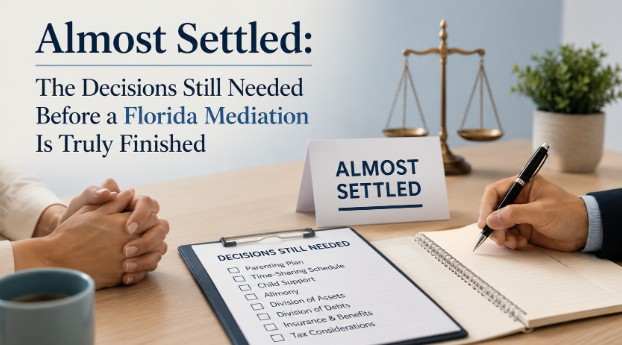
A mediated settlement agreement in Florida is not finished when spouses say “the house is settled” — it is finished when every implementation detail is written down and signed.
Reaching agreement on the marital home, a parenting schedule, or alimony is only the first layer; deadlines, valuation dates, documentation, and contingencies still require resolution before a mediator can submit the agreement under Florida Family Law Rule of Procedure 12.740.
Skipping this step remains a common reason a signed agreement later needs revisiting.
An almost-settled mediation agreement can still leave details unresolved. Ann M. Goade helps Treasure Coast families finish every settlement term before signing. Schedule a consultation.
Agreement in mediation means the spouses have settled the broad terms of an issue, not necessarily every operational detail required to carry it out.
A mediated settlement agreement is a written contract that converts a mediation session’s verbal negotiation into legally enforceable terms once signed.
Florida Family Law Rule of Procedure 12.740(f)(1) requires that if an agreement is reached “as to any matter or issue,” the agreement must be reduced to writing and submitted to the court unless the parties agree otherwise.
That rule sets a minimum — writing and signatures — not a completeness standard for the terms themselves.
A verbal “yes” on keeping the marital home is not the same outcome as a written term specifying who refinances the mortgage, by what date, and what happens if refinancing falls through.
Ann M. Goade, Esq., a Florida Supreme Court-certified family and dependency mediator based in Palm City, Florida, who has focused her legal career on family law mediation since 1993, structures sessions around identifying these gaps before drafting a written mediation agreement, not after signatures are collected.
The distinction matters because Florida’s mediation process is built to produce a document that stands on its own once the mediator’s involvement ends.
An agreement that reads as complete during a session can still omit the operational language a court, a title company, or a former spouse needs six months later.
If you’re ready to get started, call us now!
Property decisions that sound settled in a session often still need a valuation date, a documentation trail, and a transfer deadline to be complete.
Equitable distribution is the Florida legal standard that requires marital assets and liabilities to be divided fairly, starting with a presumption of an equal split under Florida Statute 61.075(1).
Florida Statute 61.075(7) sets the cutoff date used to classify assets and liabilities as marital or nonmarital — generally the earliest of a valid separation agreement date, a date the agreement itself establishes, or the petition filing date.
The valuation date is a separate question: the statute directs the court to value assets as of whatever date “the judge determines is just and equitable under the circumstances,” and different assets can be valued as of different dates within the same case.
Spouses who resolve the valuation date in their written agreement remove that ambiguity; spouses who leave it unaddressed are relying on a judge to decide later.
An agreement stating only “the house is marital property” resolves classification but not the valuation date that determines how much equity gets divided.
| Issue | Unresolved Question After Verbal Agreement | Why It Matters |
| Marital home | Who refinances, by what date, and what valuation date applies? | Property value can shift materially between the mediation session and a later refinance deadline |
| Retirement accounts | Has a plan-specific transfer order (such as a QDRO for many employer plans) been identified, and who pays for preparing it? | Dividing retirement funds without the plan’s required paperwork can delay or block the transfer; requirements vary by plan type and should be confirmed with the plan administrator |
| Business interests | Was fair market value established, and does it include enterprise or personal goodwill? | Florida Statute 61.075(6) treats these as separate categories with different tax and division consequences |
| Marital debt | Which spouse is responsible for each specific liability, in writing? | An agreement naming an asset but not its attached debt leaves the liability jointly exposed |
Property division mediation sessions that stop at “we’ll split it evenly” leave the documentation trail — deeds, account transfers, and any plan-specific paperwork retirement accounts require — for a later date that may never get scheduled.
Naming a document owner and a deadline for each marital property item during the session, rather than after, closes that gap while both spouses are still at the table.
A parenting plan that sounds complete in conversation can still miss statutory elements that Florida law treats as mandatory, not optional.
Florida Statute 61.13(2)(b) requires a parenting plan to describe daily-task responsibility, include a time-sharing schedule, designate who decides health care, school-related matters, and other activities, describe communication methods between parents, and — unless the parents agree otherwise in writing — designate exchange locations.
Parents who agree on “equal time-sharing” have resolved only one of those five required elements.
The remaining four—decision-making authority, communication method, exchange logistics, and daily-task responsibility—are often left as assumptions rather than written terms.
High-conflict parenting plans are especially vulnerable to this gap, since an assumption that works during a calm mediation session is the first thing to break down under later disagreement.
The time-sharing schedule itself also needs enough specificity to survive a change in circumstances — holiday rotation, school breaks, and how a future relocation request would be handled are all decisions that “we’ll figure it out” leaves unresolved; Florida’s relocation statute imposes its own notice and procedural requirements that a general assumption does not satisfy.
Unresolved parenting or support details can stall a divorce for months. Ann M. Goade helps translate verbal agreements into complete terms. Request a mediation session.
If you’re ready to get started, call us now!
Settling on a dollar amount for alimony or child support leaves payment mechanics, duration, and modification triggers as separate decisions still needing resolution.
Florida Statute 61.13(1)(b) requires every child support order to address health insurance responsibility when coverage is reasonable in cost and accessible to the child — a term that a verbal “I’ll cover the kids’ insurance” does not satisfy on its own.
Alimony terms typically need a payment method (income deduction order versus direct payment), a start date, and named circumstances that would modify or terminate the obligation, since Florida’s alimony framework applies different rules depending on the type of alimony awarded.
Child support figures carry a similar gap — an agreed number without an agreed payment mechanism or review trigger leaves enforcement questions unanswered if a payment is missed.
An agreement that depends on a future event — a refinance, a sale, a job change — is incomplete until it also states what happens if that event does not occur. Verbal agreements reached during mediation frequently include conditional language: “the house sells, and then the proceeds get split.”
What is missing is the fallback: what happens if the house does not sell within the agreed window, or sells for less than expected.
Financial mediation sessions that build in a contingency plan — a backup date, a price-reduction trigger, or a default division if the primary event fails — convert a conditional promise into a fully specified term.
Without that fallback language, a failed contingency can send both spouses back to the negotiating table to interpret an agreement that never specified what should happen next.
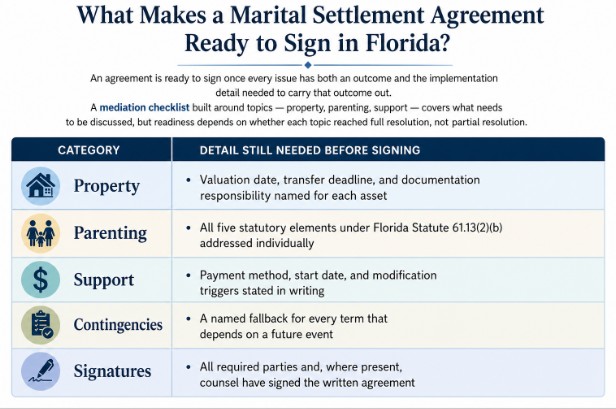
An agreement is ready to sign once every issue has both an outcome and the implementation details needed to carry it out.
A mediation checklist built around topics — property, parenting, support — covers what needs to be discussed, but readiness depends on whether each topic reached full resolution, not partial resolution.
| Category | Detail Still Needed Before Signing |
| Property | Valuation date, transfer deadline, and documentation responsibility named for each asset |
| Parenting | All five statutory elements under Florida Statute 61.13(2)(b) addressed individually |
| Support | Payment method, start date, and modification triggers stated in writing |
| Contingencies | A named fallback for every term that depends on a future event |
| Signatures | All required parties and, where present, counsel have signed the written agreement |
The goal of family law mediation is to produce a complete, signable agreement in one session. Still, under Florida’s neutrality standard, a mediator’s role is to surface these gaps for the spouses to resolve—not to decide the outcome for them.
A Florida judge reviewing a submitted mediated settlement agreement acts under Florida Family Law Rule of Procedure 12.740, which directs the court to take action on a filed agreement as required by law; the specific review — and whether court approval is required at all — can differ depending on which issues the agreement resolves, since property terms, child-related terms, and support terms are not treated identically under Florida law.
Florida courts frequently require mediation before a contested family law hearing, reflected in mandatory family mediation referral orders across Florida’s judicial circuits. Still, a court-ordered referral does not, by itself, determine how a court will review a specific agreement once submitted.
Because the review standard depends on the issues involved, resolving implementation details during mediation—rather than leaving them for a later hearing—is a practical way to reduce the number of open questions a case presents to the court.
Following the five steps of divorce mediation through to a fully resolved written term, rather than stopping at verbal agreement, keeps that number as low as possible.
What is a mediated settlement agreement in Florida?
A mediated settlement agreement is the written, signed document that records the terms spouses reach during Florida family mediation. It becomes legally enforceable once signed and is typically submitted to the court, where it can be incorporated into the final divorce judgment under Florida law.
Is a verbal agreement reached in mediation legally binding in Florida?
Florida Family Law Rule of Procedure 12.740(f)(1) requires an agreement reached in covered family mediation to be reduced to writing and signed before submission to the court. A verbal agreement alone does not satisfy that requirement; enforceability outside this rule depends on case-specific legal factors.
What happens if spouses agree on some issues in mediation but not others?
A partial agreement can still be reduced to writing and submitted for the resolved issues while remaining issues proceed to further negotiation or a court hearing. Florida’s mediation rules allow partial resolution; it does not require every issue to settle in one session to have value.
Who decides the valuation date for marital property in Florida mediation?
Spouses can resolve the valuation date themselves by including it in their written settlement agreement. Absent that agreement, Florida Statute 61.075 directs the court to value assets as of whatever date is just and equitable, and different assets can be valued as of different dates.
Can a Florida mediated settlement agreement be changed after both spouses sign it?
Property division terms are generally difficult to modify once signed and court-approved. Parenting plan and time-sharing modifications require a substantial and material change in circumstances under Florida Statute 61.13(3). Alimony and child support modification standards differ by obligation type and should be confirmed with counsel.
What happens if one spouse doesn’t follow through on a mediated agreement?
Enforcement options depend on how the agreement was incorporated into a court order or judgment and which specific obligation was breached. Courts typically enforce property and support terms, and remedies can include a motion for contempt.
Does a Florida judge have to approve a mediated settlement agreement?
Whether court approval is required, and what a judge examines, depends on which issues the agreement resolves, since Florida treats property, child-related, and support terms differently. Rule 12.740 directs the court to act on a submitted agreement as required by law.
How long does it take to finalize a divorce after mediation in Florida?
Timing depends on whether the agreement is complete when submitted, whether the case is contested or uncontested, and the circuit’s current docket. Agreements that leave implementation details unresolved typically require additional steps before a case can be finalized in Florida courts.
What if the parenting plan doesn’t address every possible situation?
Florida Statute 61.13(2)(b) sets minimum required elements, but a parenting plan cannot anticipate every future scenario. Well-drafted plans build in a general decision-making and communication framework, so unaddressed situations can be resolved without returning to court.
Do both spouses need separate attorneys to review a mediated settlement agreement in Florida?
A mediator remains neutral and does not represent either spouse, which is why many spouses choose independent legal review before signing. Whether separate representation is required or advisable can depend on the issues involved, and this question is best confirmed with a licensed Florida attorney.
An almost-settled agreement can still turn into a future dispute. Ann M. Goade helps Florida families finish mediation completely, not just partially. Schedule a consultation.


Proudly Serving Areas
Navigation
Practice Areas
Contact Us