

We now offer Virtual Mediations using Enhanced Video Conferencing
Originally published: March 2026
By Ann M. Goade, Esq., Florida Supreme Court Certified Family Mediator and Family Law Attorney
Data last verified: March 2026
A child-centered parenting plan in Florida is a court-filed, structured agreement that prioritizes a child’s developmental and emotional needs over parental disputes. Effective Florida parenting plans in 2026 address three required components: timesharing schedules, decision-making authority designations, and parent-to-parent communication protocols.
High-conflict cases require additional structure: parallel parenting frameworks, Florida court-accepted communication platforms, and neutral, safe exchange procedures that minimize the child’s exposure to conflict at every transition.
Mediation is the preferred resolution tool for high-conflict Florida parenting cases, reducing costly court-ordered interventions and protecting children from the long-term psychological impact of sustained parental conflict.
Ann Goade is a Florida Supreme Court Certified Family Law Mediator who built her Palm Beach County, Martin County, and St. Lucie County practice around families navigating high-conflict transitions.
Florida families who draft parenting plans through certified family law mediation, rather than through contested litigation, demonstrate higher compliance rates and lower rates of return to court within the first three years.
Traditional co-parenting requires a functional communication channel, shared real-time decision-making, and both parents’ ability to occupy the same physical space at school events and medical appointments.
Florida families navigating high-conflict divorce proceedings rarely meet those conditions, and courts do not require them to.
Parallel parenting is a legally recognized Florida parenting arrangement designed specifically for high-conflict cases, in which each parent operates independently during their own timesharing period, with minimized direct contact between the parents and no requirement for joint attendance at events.
Florida family courts and the Florida Supreme Court-certified mediators accept parallel parenting as a distinct and legitimate alternative to traditional co-parenting.
The choice between co-parenting and parallel parenting is not a matter of personal preference.
The choice determines whether a child is protected from parental conflict or exposed to it at every transition point.
Ann Goade selects the appropriate framework based on the documented conflict history, communication patterns, and the statutory best-interest factors under Florida Statute 61.13.
| Co-Parenting | Parallel Parenting | Ann Goade’s Recommendation |
| Requires frequent direct parent-to-parent communication | Eliminates the required direct contact between parents | Parallel parenting for any case with a documented conflict history |
| Appropriate when conflict is low or fully resolved | Designed for cases with ongoing high-conflict dynamics | Co-parenting only when both parties demonstrate consistent good faith over time |
| Schedule adjustments made by mutual parental agreement | Fixed schedule eliminates ongoing negotiation friction | Rigid Year 1 structure; flexibility reviewed at Year 2 modification session |
| Both parents attend school events and medical appointments jointly | Each parent attends school and medical events separately during their scheduled time | Separate attendance until a neutral co-parenting therapist clears joint events in writing |
| Child observes parents cooperating directly | The child is structurally insulated from parental conflict | Insulation first; cooperation is a long-term goal, not a baseline assumption |
Parallel parenting is not a lesser arrangement — parallel parenting is a protective legal structure. Child development research consistently identifies a child’s direct exposure to parental conflict, not parental separation itself, as the primary long-term harm factor.
A parallel parenting plan that removes children from the conflict crossfire produces lower rates of behavioral disruption and emotional distress than a co-parenting model that generates ongoing disputes at every shared transition.
If you’re ready to get started, call us now!
Ann Goade designates a specific co-parenting communication platform by name in every Mediated Parenting Agreement she drafts for high-conflict cases.
OurFamilyWizard and TalkingParents are the two platforms Florida family courts most consistently accept as documentary evidence.
Both platforms create a timestamped, unalterable record of all parent-to-parent communications, so that neither party can alter message history before presenting it as court evidence.
| OurFamilyWizard | TalkingParents |
| Best for: cases involving child support expense disputes and financial co-parenting tracking | Best for: cases where certified, court-ready communication logs are the primary evidentiary need |
| Features: expense log, medical records organizer, shared parenting calendar | Features: fully archived, uneditable message record designed for court submission |
| Cost: approximately $10 to $13 per parent per month (as of March 2026) | Cost: free basic tier; $9.99 per month for certified records access (as of March 2026) |
| Admissibility: OurFamilyWizard records accepted in Palm Beach County family court proceedings | Admissibility: TalkingParents offers notarized records packages formatted for court exhibits |
| Ann Goade recommends that when financial disputes accompany the parenting conflict | Ann Goade recommends that when one parent has a documented history of distorting or misrepresenting communications |
OurFamilyWizard and TalkingParents both remove the incentive to distort communications because the unalterable, timestamped record remains accessible to both parties and to the court at all times.
Ann Goade specifies the designated platform by name within the Mediated Parenting Agreement, eliminating any ambiguity about which communication system governs the case.
Ann Goade serves as a neutral facilitator certified by the Florida Supreme Court, not as an advocate for either parent. Florida Supreme Court certification requires Ann Goade to remain structurally impartial throughout all mediation proceedings:
Ann Goade does not validate grievances, advocate for either parent’s position, or render opinions on fault or credibility.
In high-conflict family law mediation sessions, Ann Goade’s certified neutrality interrupts the adversarial attribution cycle that escalates when parents communicate directly.
Directing both parties through a Florida Supreme Court Certified Mediator refocuses the discussion on the statutory best interests of the child rather than on relitigating marital grievances.
Structural mediator neutrality is the most consistently effective tool for reaching durable parenting agreements in high-conflict Florida cases where direct negotiation has failed — because it removes the adversarial dynamic that direct negotiation sustains.
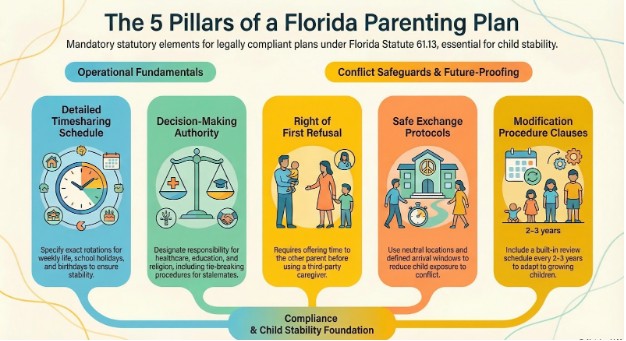
Florida Statute 61.13 requires every parenting plan submitted to a Florida family court to address specific structural components.
As of 2026, any plan that omits these five elements risks rejection at the ratification stage or disputes over non-compliance post-order.
Ann Goade uses this five-element framework as the baseline structure for every parenting plan mediation session she conducts in Palm Beach County, Martin County, and St. Lucie County.
If you’re ready to get started, call us now!
Parenting plan noncompliance in Florida does not automatically require a contempt-of-court filing. A contempt proceeding is expensive, adversarial, and counterproductive in active parenting cases because it escalates conflict at the precise moment when de-escalation would most directly benefit the child.
Ann Goade, Florida Supreme Court Certified Family Law Mediator, recommends enforcement through certified family law mediation as the first response to parenting plan non-compliance.
A mediated enforcement session identifies whether non-compliance stems from a practical barrier or a deliberate violation, then produces a written, signed clarification or modification order that carries full legal weight — so both parents leave with a documented, enforceable resolution rather than an escalated dispute.
Florida family courts take documented noncompliance seriously when the complying parent has a documented history of good-faith mediation attempts.
If violations persist after documented mediation efforts, a motion for contempt or a modification petition becomes the appropriate legal escalation.
Florida family courts do not recognize a minimum age at which a child can independently determine their primary residence. The controlling legal standard under Florida Statute 61.13 is the best interests of the child, evaluated across 20 statutory factors. A child’s stated residential preference constitutes one of those 20 factors.
Florida family court judges assign increasing evidentiary weight to a child’s stated residential preference as the child demonstrates greater developmental maturity — most commonly in the adolescent years.
Judges also assess whether the preference was influenced by a parent, whether the preference aligns with the child’s educational and developmental stability, and whether the preference is consistent with all other statutory best-interests factors under Chapter 61.13.
In Ann Goade’s parenting plan mediation process, a child’s expressed preferences integrate into the final parenting agreement in legally grounded, practically workable terms — without requiring the child to testify in court or bear personal responsibility for the residential outcome.
Ann Goade has managed this process for families across Palm Beach County, Martin County, and St. Lucie County with documented attention to child emotional protection throughout.
Florida Statute 61.13001, the Florida Relocation Statute, governs every proposed parental move that changes a child’s principal residence by more than 50 miles for a period exceeding 60 days.
How Florida Statute 61.13001 applies depends on which of three distinct family scenarios the case falls into.
| Relocation Scenario | Typical Resolution Path | Ann Goade’s Role |
| Both parents agree and communicate cooperatively | Signed written agreement submitted to the Florida family court; no court hearing required | 1 to 2 mediation sessions to draft updated timesharing schedule, transportation logistics, and transportation cost-sharing terms |
| One parent reluctantly agrees — the most common scenario in Florida relocation cases | Agreement is structurally achievable but requires a documented structure to hold | 2 to 3 mediation sessions: addresses reluctant parents’ specific concerns, builds a revised timesharing schedule, and produces a transportation cost-sharing agreement — this scenario is where certified mediation delivers its highest value over litigation |
| One parent objects outright to the proposed relocation | Relocating parent files a relocation petition; the Florida family court evaluates the child’s best interests under Statute 61.13001 | Pre-petition mediation session establishes a documented good-faith effort before filing, which Florida courts weigh favorably in subsequent proceedings |
Ann Goade’s virtual mediation service is particularly effective for Florida relocation disputes where one parent has already moved to another county or state.
Both parties participate remotely via a secure video session, reducing travel costs and scheduling friction while producing the same legally enforceable Mediated Parenting Agreement as in-person sessions.
Contested relocation litigation in Florida family court ranks among the most expensive proceedings in the practice area.
Florida parents who resolve relocation disputes through certified mediation before filing court petitions consistently achieve shorter resolution timelines, lower total legal costs, and higher post-agreement compliance rates than parents who proceed directly to litigation.
A Florida family court judge imposes a court-ordered parenting plan. A Florida Supreme Court Certified Mediator facilitates a negotiated parenting agreement.
That structural difference in process produces a measurable difference in post-order compliance: parents who actively participated in drafting their own parenting agreements comply at significantly higher rates than parents who received court-imposed plans, because participation generates ownership of the outcome.
Family mediation outcome research consistently demonstrates that parental agency in the drafting of agreements is the primary driver of long-term plan durability — not the specific terms of the plan.
A plan both parents negotiated holds because both parents have a stake in it.
Ann Goade, Florida Supreme Court Certified Family Law Mediator, conducts parenting plan mediation in one to three sessions for most cases in Palm Beach County, Martin County, and St. Lucie County.
The resulting Mediated Parenting Agreement is signed by both parties, ratified by the Florida family court, and converted into a legally enforceable court order.
The process preserves full confidentiality under Florida Statute 44.405 and produces a family-specific agreement, not a generic court template.
Florida parents who have attempted direct negotiation and reached an impasse can access pre-suit family law mediation through Ann Goade without either party needing to file a petition first — preserving confidentiality, reducing cost, and preventing the adversarial escalation that litigation filings trigger.
Ann Goade is a Florida Supreme Court Certified Family Law Mediator serving Palm Beach County, Martin County, St. Lucie County, and the Treasure Coast. Schedule a confidential parenting plan consultation and receive a child-centered, court-ready parenting agreement drafted in one to three sessions — without a courtroom.
What makes a parenting plan child-centered rather than parent-centered?
A child-centered Florida parenting plan structures timesharing schedules, decision-making authority, and exchange transitions around the child’s developmental needs, not parental preferences. Child-centered plans include safe exchange protocols, requirements for communication platforms, and triggers for modification to protect children from exposure to conflict.
Does Florida law require mediation before a parenting plan goes to court?
Florida law does not universally mandate mediation before a parenting plan is filed, but Florida family courts routinely order it under Civil Procedure Rule 1.700. Parents may also initiate pre-suit mediation voluntarily before filing.
How much does parenting plan mediation cost in Florida in 2026?
Florida parenting plan mediation costs approximately $150 to $400 per party per session as of 2026, compared to $5,000 to $20,000 or more per party in contested litigation. Mediation resolves the same issues at a fraction of the cost.
Can a Florida parenting plan be modified after the court ratifies it?
Yes, a Florida family court will modify a ratified parenting plan upon showing a substantial, material, and unanticipated change in circumstances affecting the child’s welfare, as required under Florida Statute 61.13.
What is the legal difference between timesharing and custody in Florida?
Florida replaced custody and visitation with timesharing in 2008. Timesharing defines when each parent has physical care of the child. Parental responsibility defines which parent holds decision-making authority over healthcare, education, and welfare.
Is virtual mediation legally valid for Florida parenting plan agreements?
Yes, virtual family law mediation is fully valid under Florida law. It produces the same legally enforceable Mediated Parenting Agreement as in-person sessions, making it effective for parents in different counties or states.
For a confidential, child-focused mediation session, contact Ann Goade directly or review the family law mediation FAQs to understand exactly how the parenting plan mediation process works.


Proudly Serving Areas
Navigation
Practice Areas
Contact Us