

We now offer Virtual Mediations using Enhanced Video Conferencing
Originally published: September 2026
By Ann M. Goade, Esq., Florida Supreme Court Certified Family Mediator and Family Law Attorney
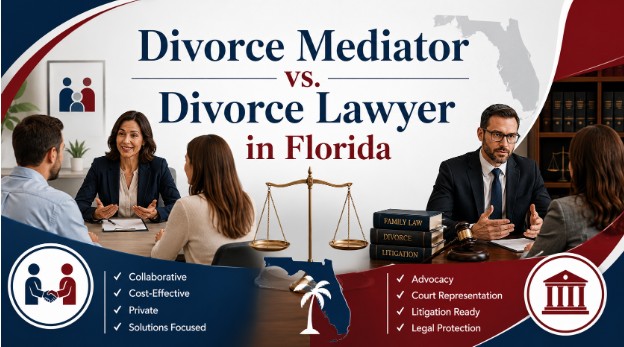
A divorce mediator is a neutral professional who helps both spouses negotiate their own settlement, while a divorce lawyer is an advocate who represents only one spouse’s interests.
Most Florida divorces benefit from mediation first, since a Florida court rule lets spouses mediate without an attorney present and requires completion within 75 days.
Not sure whether you need a mediator, a lawyer, or both? Schedule a mediation with Ms Goade to find the right starting point.
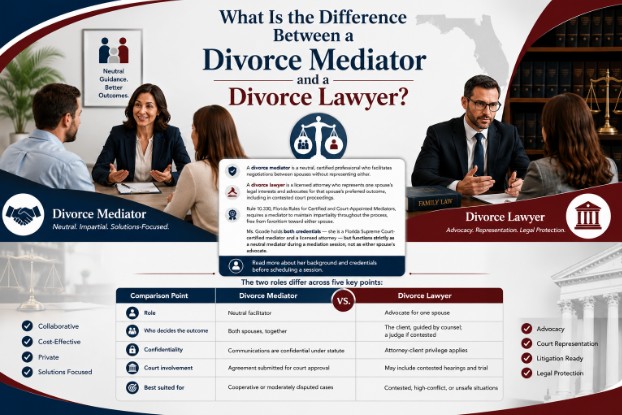
A divorce mediator is a neutral, certified professional who facilitates negotiations between spouses without representing either. A divorce lawyer is a licensed attorney who represents one spouse’s legal interests and advocates for that spouse’s preferred outcome, including in contested court proceedings.
Rule 10.330, Florida Rules for Certified and Court-Appointed Mediators, requires a mediator to maintain impartiality throughout the process, free from favoritism toward either spouse.
Ms. Goade holds both credentials — she is a Florida Supreme Court-certified mediator and a licensed attorney — but functions strictly as a neutral mediator during a mediation session, not as either spouse’s advocate.
The two roles differ across five key points: who they represent, who decides the outcome, confidentiality, court involvement, and which situations each suits best.
| Comparison Point | Divorce Mediator | Divorce Lawyer |
| Role | Neutral facilitator | Advocate for one spouse |
| Who decides the outcome | Both spouses, together | The client, guided by counsel, a judge if contested |
| Confidentiality | Communications are confidential under statute | Attorney-client privilege applies |
| Court involvement | Agreement submitted for court approval | May include contested hearings and a trial |
| Best suited for | Cooperative or moderately disputed cases | Contested, high-conflict, or unsafe situations |
If you’re ready to get started, call us now!
Mediation is generally less expensive than litigation because both spouses share the cost of a single neutral mediator, rather than each paying a separate attorney to prepare for a contested hearing.
Rule 12.740 requires family mediation to be completed within 75 days of the first mediation conference, unless the court orders otherwise.
Contested litigation has no equivalent deadline and can drag on for months while attorneys complete financial discovery, file motions, and prepare for trial.
Ms. Goade’s virtual mediation option eliminates travel time, allowing spouses to attend sessions from wherever they live.
A divorce mediator is the right choice when both spouses are willing to negotiate directly and want to control the outcome themselves rather than leaving it to a judge.
Mediation works well for spouses who disagree on specific terms — a timesharing schedule or an alimony amount — but do not distrust each other on a fundamental level.
An equitable distribution dispute over marital property fits this same pattern, since the disagreement is usually about specific terms rather than a breakdown in trust.
This mediation practice also offers Pro Se mediation for spouses who want to resolve their divorce without hiring an attorney at all, using the mediator’s neutral guidance instead of independent legal advocacy.
Not sure if mediation fits your situation? Contact Ms. Goade to talk through your case before deciding.
If you’re ready to get started, call us now!
A divorce lawyer is genuinely necessary when one spouse’s safety, legal rights, or financial disclosure cannot be protected through neutral facilitation alone.
Domestic violence, a history of intimidation, or a serious power imbalance between spouses can undermine the voluntary, informed consent on which mediation depends.
A spouse who suspects the other is hiding assets or refusing full financial disclosure needs an attorney’s subpoena power and discovery tools, which a mediator does not have.
A mediator who is also an attorney, including Ms. Goade, cannot give either spouse individual legal advice during mediation — spouses who want advice about their own family law rights should consult independent counsel before signing any agreement.
Mediation communications do carry their own statutory confidentiality, but that protection is separate from attorney-client privilege.
Yes. A number of Florida spouses consult a lawyer for independent legal advice while mediating their divorce with a neutral mediator under Rule 12.740.
Rule 12.740 allows counsel to attend mediation sessions or remain available outside the room, so a spouse can negotiate directly while still having legal advice on standby.
This combined approach lets spouses control the negotiation themselves, through mediation, while confirming that any agreement protects their individual legal rights before it becomes a final court order.
What is the main difference between a divorce mediator and a divorce lawyer?
A divorce mediator is neutral and helps both spouses reach their own agreement, while a divorce lawyer represents and advocates for only one spouse’s interests in the case. A mediator cannot give either spouse individual legal advice during the mediation process itself.
Is mediation cheaper than hiring a divorce lawyer?
Generally, yes. Mediation typically costs less overall because both spouses share the fee of one neutral mediator, rather than each spouse separately paying an attorney to prepare for contested hearings, financial discovery, motions, and a possible trial in circuit court.
How long does divorce mediation take compared to litigation with a lawyer?
Rule 12.740 requires mediation to conclude within 75 days of the first mediation session, unless the court orders otherwise. Contested litigation with a lawyer carries no equivalent deadline and often extends across additional months of court proceedings.
Can I use a mediator instead of a divorce lawyer entirely?
Yes. Rule 12.740 allows spouses to mediate without an attorney present, and Pro Se mediation lets spouses reach a full property division and parenting agreement using only the mediator’s own neutral guidance throughout the entire process.
Does a mediator represent either spouse in a Florida divorce?
No. Rule 10.330 requires a certified mediator to remain impartial throughout the entire mediation process and prohibits favoring either spouse’s position in any way, even when that mediator also happens to be a licensed practicing attorney.
When should I hire a divorce lawyer instead of only using a mediator?
Hire a divorce lawyer when there is domestic violence, a serious power imbalance between spouses, or suspected hidden assets, since these situations require legal advocacy, subpoena power, and formal discovery tools that a neutral mediator simply does not have.
Can I bring my own lawyer to a mediation session?
Yes. Rule 12.740 permits attorneys to attend mediation sessions alongside their clients, so a spouse can negotiate directly with the other side while still having independent legal advice available in the very same room.
Will a mediator tell me if my settlement is fair?
A mediator can point out possible outcomes and discuss the merits of a position, but Florida’s own mediator ethics rules prohibit offering either spouse individual legal advice or a personal opinion on how a judge would ultimately rule.
Is what I say in mediation confidential in the same way it is with a lawyer?
Yes. Florida Statute 44.405 makes most mediation communications confidential, similar in practical effect to attorney-client privilege, though the two protections arise under different legal sources and carry their own separate statutory exceptions.
Do I need a lawyer to make a mediated agreement legally binding?
No. A signed mediated agreement is submitted to the circuit court for approval and becomes a binding order once a judge formally approves it, though either spouse may still choose to have their own independent counsel review it first.
Ready to resolve your divorce without a contested court battle? Schedule a mediation with Ms. Goade and find out if mediation is the right path for your family.


Proudly Serving Areas
Navigation
Practice Areas
Contact Us