

We now offer Virtual Mediations using Enhanced Video Conferencing
Originally published: December 2025

Going through a divorce in Florida? Most people want to keep their personal business out of the spotlight. Mediation offers a more private way to resolve matters than litigation.
In Florida, most divorce mediation communications are confidential and generally protected from being used as court evidence—except for specific statutory exceptions and waiver rules. But the final settlement agreement and divorce papers you file with the court? Those become public record.
This means what you discuss in mediation is protected, but the results aren’t always private by default.
Knowing what stays behind closed doors and what ends up public helps you make smarter choices about your divorce.
Florida mediation confidentiality laws protect conversations between spouses and their mediator.
Still, a few exceptions and gray areas can catch people off guard. It’s smart to know the rules before you start family mediation so you don’t get caught off guard.

Florida generally protects mediation communications as confidential and grants a privilege against later testimony about what was said in mediation. But confidentiality has specific legal exceptions, and the final written agreement and court filings can change what becomes public.
Confidential means the information remains private between the parties involved in mediation. Under Florida law, mediation communications are confidential, except as provided by statute, which includes specific exceptions and waiver scenarios.
Participants generally may not disclose mediation communications to non-participants, but they may share them with other participants and with their own counsel, and statutory exceptions can apply.
Privileged takes it a bit further. Privileged info can’t be used as evidence in court.
In Florida divorce mediation, communications are both confidential and privileged.
This allows couples to speak candidly during sessions without worrying that their words will come back to bite them. The mediator generally cannot be compelled to testify about mediation communications, subject to Florida’s statutory exceptions.
But here’s the thing—while the content of mediation discussions remains confidential, a written, signed settlement agreement isn’t automatically confidential. You and your ex must agree to keep it confidential if that’s what you want.
Ann Goade helps Florida couples mediate divorce privately, clarify confidentiality boundaries, and avoid costly court fights—request your mediation date today. Schedule an appointment.
If you’re ready to get started, call us now!

Mediation communications include anything said, written, or shared during the divorce mediation process. This covers verbal statements, written notes, proposals, and even gestures or body language in the room.
During mediation, spouses often make settlement offers they wouldn’t want a judge to hear. One spouse may offer to take less alimony to settle. That’s protected.
Admissions are protected, too. Maybe a husband admits he hid some assets, or a wife says she exaggerated her expenses. These honest statements help negotiations move forward without fear of consequences later.
“Trial balloons” are informal ideas people test to see what sticks. For example, someone might suggest keeping the house in exchange for giving up retirement accounts. Even if the other side shoots it down, the mediator can’t mention it in court.
Written offers and mediation-specific communications are generally protected, but documents and facts that are otherwise discoverable do not become shielded simply because they were discussed or exchanged during mediation.
Mediation is typically conducted privately with only the parties, mediator, and counsel/authorized participants present.
Mediator ethics require maintaining the confidentiality of information disclosed in mediation, with narrow legal exceptions that support candid discussion and problem-solving.
Usually, it’s just the divorcing spouses, the mediator, and sometimes their lawyers. Small group, less risk. Fewer people hear sensitive stuff about money, parenting, or private matters.
Extra people can create problems:
Courtrooms are the opposite. Anyone can walk in and hear testimony about income, assets, or parenting disputes. Court records related to custody and finances remain open to the public for years.
Bringing friends, family, or extra advisors to mediation? That just adds more ways private information about your kids’ schedules or finances could be disclosed.
Mediation may be confidential, but family court filings are generally public, while some information can be designated confidential or sealed in limited situations under Florida court record rules.
Many case filings are available in the court record, though certain sensitive information is protected by rules and redaction requirements, and additional sealing may be possible in narrow circumstances.
The mediation room gives you privacy. However, filing the divorce petition changes the situation. Once either spouse submits paperwork to the family court, your case goes public.
What becomes public:
This applies to both contested and uncontested divorces. The court doesn’t care if you mediated or not—the final agreement goes in the file either way.
Financial documents like bank statements, tax returns, and property values also become part of the record if you submit them as evidence.
Anyone can check out these files at the courthouse or online. Only specific information, such as Social Security numbers or bank account details, is protected to prevent identity theft.
During mediation, most talks about property, alimony, and child custody stay confidential. What’s said in mediation doesn’t go to court, so couples have the freedom to negotiate openly.
What Stays Private:
What May Become Public:
Discussions and documents shared during mediation sessions stay private and protected under Florida law. But once you file an agreement with the court, those terms usually become public record.
The big difference? The process stays confidential, but the results often don’t. If you’re worried about privacy—especially in high-net-worth cases—talk to your lawyer about confidentiality clauses in your agreement. That can help keep sensitive financial details out of public view.
Florida law protects most mediation discussions. Still, specific exceptions allow disclosure if safety, legality, or fairness require it. These rules apply whether you’re in voluntary or court-ordered mediation.
When someone threatens harm or reveals abuse, mediators and participants can break confidentiality. This covers child abuse, elder abuse, or threats to harm someone in the future.
When disclosure prevents a crime, the law allows the disclosure of confidential information. If someone admits to plans to commit a crime or needs to disclose information to stop illegal activity, mediation confidentiality exceptions permit disclosure.
When both parties agree in writing, they can share mediation communications. If everyone signs off on releasing certain information, confidentiality no longer applies to those items.
When proving or defending against mediation misconduct, parties can share relevant communications. This arises when someone claims the mediator acted poorly or when participants violated mediation rules.
A signed written settlement agreement reached during mediation is not automatically confidential or privileged unless the parties agree otherwise and the law permits. Courts require these agreements to finalize cases, and discussions during mediation remain confidential while the final terms are made public.
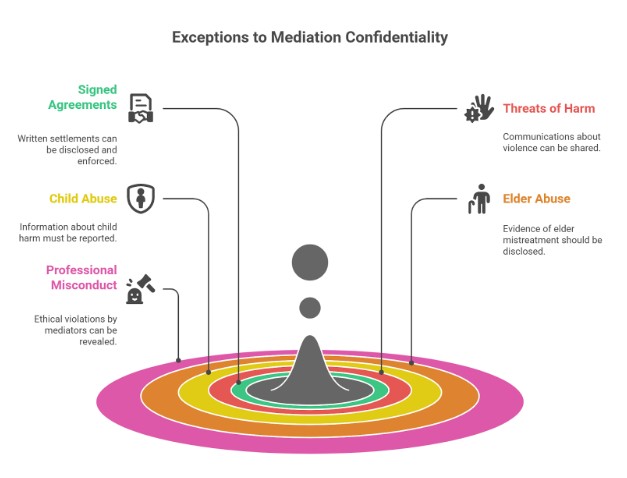
While Florida Statute 44.405 makes mediation communications confidential, the law recognizes several essential exceptions. These exceptions allow certain information to be shared under specific situations.
Key Exceptions Include:
Violations of confidentiality rules may result in legal remedies. Courts can impose sanctions on parties who breach confidentiality.
In court-ordered mediations, judges have additional power to address violations. They might order parties to pay costs, attorney’s fees, or mediator’s fees as penalties.
Participants typically share mediation communications only with other participants or their own lawyers. This keeps settlement talks private while allowing people to speak with their legal counsel.
Want clarity on what stays confidential and what can become public in your Florida divorce? Book a session with Ann Goade today. Contact us today.
If you’re ready to get started, call us now!
Florida mediator ethics emphasize confidentiality and specifically address caucuses: information learned in private should not be disclosed to the other side without consent. This is a major reassurance point for anxious parties—but it’s still wise to clarify caucus ground rules at the start.
During a private caucus, the mediator speaks with one party alone. These conversations are different from the general mediation confidentiality rules.
What people can usually assume:
What needs confirmation upfront:
Many mediators use a process in which everything remains confidential unless a party consents to sharing. Others assume they can share unless told otherwise.
The approach varies by mediator, so spouses should ask their mediator directly how they handle caucus information before speaking freely. It’s worth double-checking.
Most privacy failures aren’t legal exceptions—they’re avoidable process mistakes: bringing unnecessary third parties, oversharing in emails/texts, or casually repeating mediation details later. Use a simple privacy plan that matches your risk level and keeps negotiations clean.
If there are safety concerns, threats, or coercion, prioritize personal safety and get case-specific legal guidance—Florida confidentiality has defined exceptions. It does not protect communications used to plan crimes or threats.
Once both spouses sign a settlement agreement, the confidentiality that protected their mediation discussions shifts. The signed divorce agreement becomes part of the court process, meaning certain details move from private to public record.
After both parties sign the settlement agreement, one party submits the document to the court for approval.
The judge reviews it to ensure it complies with Florida law and protects everyone’s rights—especially when children are involved.
Once the judge approves it, the agreement becomes part of the final divorce decree. This court order gets filed in public records, so unless you take extra steps to seal something, anyone can look it up.
Conversations during mediation stay confidential. But the final divorce agreement—like how property gets divided or what the parenting plan looks like—goes public once the court enters the order.
Some couples seek to include confidentiality clauses in their divorce settlement to limit what each party can disclose outside of court. These clauses can’t hide the court record itself, but they do keep spouses from discussing financial or personal details with others.
Protect your privacy while working toward a fair Florida settlement—choose mediation that keeps negotiations off the courtroom stage. For available dates, Contact Ann Goade.
Is divorce mediation confidential in Florida?
Generally yes. Florida law provides that mediation communications are confidential, and participants may not disclose them to non-participants in Florida divorce cases. This supports candid negotiation, subject to statutory exceptions and waiver rules.
Can what I say in mediation be used against me in court in Florida?
Typically no. Florida’s mediation statute makes mediation communications confidential and creates a privilege that generally precludes their disclosure in court. Exceptions can apply, including threats or planned crimes, mandatory reporting, or challenges to a settlement’s validity.
Are private caucus conversations with the mediator confidential?
Yes. Under Florida mediator ethics rules, information a mediator learns in a private caucus may not be disclosed to the other side without the disclosing party’s consent, unless disclosure is required or permitted by law.
Is a mediated settlement agreement confidential after we sign it?
Not automatically. Florida courts note that a signed mediated settlement agreement is not confidential unless the parties agree otherwise and the law permits it. Once filed with the court, it may become part of the record.
What are the main exceptions to mediation confidentiality in Florida?
Florida law lists exceptions where confidentiality/privilege does not apply, such as when all parties waive it, when disclosure is required by law (including certain mandatory reports), or when communications involve threats, planned crimes, or challenges to a settlement’s validity.
Can I bring a friend or family member to mediation while keeping it confidential?
Only if everyone agrees and the mediator allows it. Florida’s confidentiality rule restricts the disclosure of mediation communications to non-participants. Inviting a third party can reduce privacy protections and increase the risk of later disputes about what was said.
Can I record a Florida divorce mediation session?
Recording is risky. Florida law generally requires the consent of all parties to record an oral communication, so do not record mediation unless every participant clearly agrees in advance. If you plan to record, obtain explicit written permission from the mediator and each participant; otherwise, do not record.

Proudly Serving Areas
Navigation
Practice Areas