

We now offer Virtual Mediations using Enhanced Video Conferencing
Originally published: January 2021 | Updated: September 2026
By Ann M. Goade, Esq., Florida Supreme Court Certified Family Mediator and Family Law Attorney
Florida equitable distribution mediation resolves disputes over how a divorcing couple’s marital assets and liabilities are divided, without a contested circuit court hearing.
Florida Statute 61.075 requires the court to begin with a premise of equal division, then adjust only if a party proves a specific statutory factor justifies an unequal split.
Schedule a mediation with Ann M. Goade, Esq., to reach a property division agreement without a judge deciding for you.
Struggling to agree on how to divide marital property? Schedule a mediation with Ms. Goade to reach a fair division outside of court.
Equitable distribution is the legal process Florida courts use to divide a divorcing couple’s marital assets and liabilities under Florida Statute 61.075.
The term does not mean an automatic 50/50 split. Florida Statute 61.075 directs the court to begin with a premise of equal division, then adjust that starting point only if a party proves one of the statute’s listed factors justifies an unequal result.
Ms. Goade mediates these disputes for divorcing couples across Martin, Palm Beach, St. Lucie, and Indian River counties, applying the same statutory framework a judge would use in a contested family law proceeding.
Equitable distribution decisions affect other parts of a divorce, too. The property a spouse receives can shape the outcome of an alimony determination, since a court weighs each spouse’s financial resources after the division is set.
Every Florida equitable distribution proceeding follows the same statutory sequence under Florida Statute 61.075, regardless of whether the parties negotiate a settlement or a judge decides after trial.
| Step | What the Court Does |
| Set the cut-off date | Identifies the date marital classification ends — the earliest of a separation agreement date or the petition filing date |
| Classify property | Separates each asset and liability into marital or non-marital |
| Set the valuation date | Determines the date, or dates, used to value each asset |
| Distribute marital property | Applies the equal-division premise, adjusted for any proven statutory factor |
A 2024 amendment to Florida Statute 61.075 changed how courts value marital interests in a closely held business, codifying fair market value as the standard and distinguishing enterprise goodwill from personal goodwill.
The same amendment addressed the treatment of interspousal gifts of real property during distribution.
Florida law classifies every asset and liability as either marital or non-marital before a court can divide anything, and only marital property is subject to distribution.
Marital assets include property acquired and debt incurred by either spouse during the marriage, along with the enhancement in value of a non-marital asset that results from marital funds or either spouse’s efforts.
Non-marital assets include property either spouse owned before the marriage, along with property acquired separately by gift, bequest, or inheritance.
Ms. Goade walks each spouse through this classification step first, since disagreement over whether an asset is marital or non-marital is the most common source of conflict in an equitable distribution dispute.
Property can shift categories over time. If separate, non-marital funds become mixed with marital funds during the marriage, a court can reclassify the combined asset as marital property subject to division.
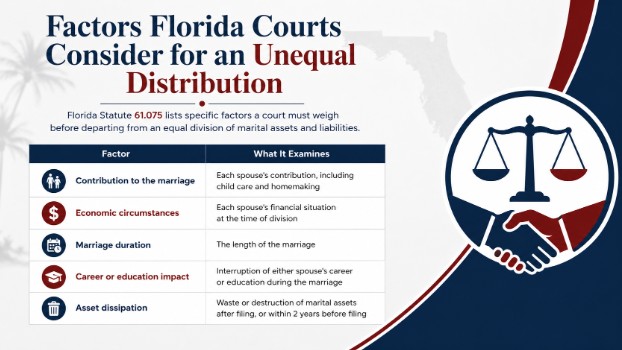
Florida Statute 61.075 lists specific factors a court must weigh before departing from an equal division of marital assets and liabilities.
| Factor | What It Examines |
| Contribution to the marriage | Each spouse’s contribution, including child care and homemaking |
| Economic circumstances | Each spouse’s financial situation at the time of division |
| Marriage duration | The length of the marriage |
| Career or education impact | Interruption of either spouse’s career or education during the marriage |
| Asset dissipation | Waste or destruction of marital assets after filing, or within 2 years before filing |
Additional statutory considerations include each spouse’s contribution to acquiring or improving marital assets, the desirability of keeping a business interest free from the other spouse’s claim, and whether retaining the marital home serves a dependent child’s best interest.
Ms. Goade applies these same factors during mediation, so both spouses negotiate against the same legal standard a judge would use at trial.
Struggling with a spouse who won’t compromise on property division? Contact Ms. Goade to mediate a fair resolution under Florida’s actual legal standard.
Equitable distribution mediation with Ms. Goade brings both spouses together with a neutral, Florida Supreme Court-certified mediator to negotiate the division of marital property directly, rather than asking a judge to decide after a contested hearing.
Ms. Goade does not represent either spouse and holds no financial interest in the outcome, so both sides negotiate on equal footing using the same statutory factors a judge would apply.
Sessions can proceed through Pro Se mediation for spouses without an attorney or through virtual mediation for spouses who cannot meet in person. A finalized property division agreement is then submitted to the circuit court for approval.
Complex assets often need this kind of direct negotiation. A marital business interest, a retirement account, or marital property that has appreciated during the marriage each require careful classification before a fair division is possible.
Florida equitable distribution proceedings require each spouse to disclose their full financial picture before any property division becomes final.
Each spouse must file a Financial Affidavit, listing income, expenses, assets, and liabilities under oath.
Ms. Goade reviews each spouse’s financial affidavit during mediation, so both parties negotiate from the same verified financial picture rather than incomplete information.
Once both spouses reach an agreement on property division, Florida’s Marital Settlement Agreement form documents the division for the court’s approval.
The Florida Bar’s own analysis of Florida Statute 61.075 confirms that courts follow a structured multi-step process to classify and value marital property before any division occurs — the same sequence Ms. Goade follows during mediation.
Ms. Goade mediates Florida equitable distribution disputes from her Palm City office at 3576 SW Sawgrass Villas Dr, Palm City, FL 34990, serving families throughout the Treasure Coast and Palm Beaches.
Martin County, Florida — Ms. Goade serves Stuart, Palm City, Jensen Beach, Hobe Sound, and Indiantown within Martin County’s 19th Judicial Circuit.
Palm Beach County, Florida — Ms. Goade serves Jupiter, West Palm Beach, Palm Beach Gardens, and Tequesta within Florida’s 15th Judicial Circuit.
St. Lucie County, Florida — Ms. Goade mediates property division disputes for families in Port St. Lucie, Fort Pierce, and Tradition as a confidential alternative to contested St. Lucie County Circuit Court proceedings.
Indian River County, Florida — Ms. Goade provides equitable distribution mediation for Vero Beach, Sebastian, and Fellsmere families, resolving property division disputes without extended Indian River County Circuit Court timelines.
Virtual mediation is available statewide for spouses who cannot attend an in-person session.
What does “equitable distribution” mean in a Florida divorce?
Equitable distribution is the legal process Florida courts use to divide marital assets and liabilities under Florida Statute 61.075. The term means a fair division, not necessarily an equal one, though the court starts from an equal-division premise.
Does Florida law require a 50/50 split of marital property?
No. Florida Statute 61.075 directs courts to begin with a premise of equal division, but a spouse can present evidence of a specific statutory factor — such as asset dissipation or an economic imbalance between the spouses — that justifies an unequal result instead.
How does a court decide what counts as marital property?
Assets and debts acquired during the marriage are generally marital, regardless of whose name appears on the title or account. Property owned before the marriage, or received separately as a gift or inheritance, is generally non-marital and set aside first.
Can separate property become marital property in Florida?
Yes. If non-marital funds become mixed with marital funds during the marriage, or if marital funds or effort increase the value of a separate asset, a court can classify some or all of that value as marital property subject to division.
What financial documents does equitable distribution require?
Each spouse must file a Financial Affidavit, under oath, disclosing income, expenses, assets, and liabilities before the circuit court. Once spouses reach an agreement, a Marital Settlement Agreement documents the full division of property for the court’s final approval.
How does a marital business get divided in a Florida divorce?
A 2024 amendment to Florida Statute 61.075 requires courts to value a closely held business at fair market value and to separate enterprise goodwill, a marital asset, from personal goodwill tied only to the owner-spouse’s reputation or professional skill.
Does dissipating marital assets affect property division?
Yes. Florida Statute 61.075 allows a court to award a larger share of the remaining marital estate to the other spouse if one spouse intentionally wasted, depleted, or destroyed marital assets after filing for divorce, or within 2 years before filing.
Can spouses divide property through mediation instead of a trial?
Yes. Mediation lets both spouses negotiate a full property division agreement directly with a neutral, certified mediator, using the same statutory factors a judge would apply at trial, then submit the finalized agreement to the circuit court for approval.
Does the marital home always go to the spouse with children?
Not automatically. A court considers whether retaining the marital home serves a dependent child’s best interest and whether keeping the residence is financially feasible for both parties, weighing that alongside every other statutory factor under Florida Statute 61.075.
How long does equitable distribution mediation take compared to litigation?
Mediation typically resolves property division in one to three sessions, compared to months of financial discovery and formal motion practice in contested litigation, because both spouses negotiate the division directly instead of waiting on a crowded circuit court calendar.
Don’t leave your property division to a judge who doesn’t know your family. Schedule a mediation with Ms. Goade and reach a fair agreement on your own terms.


Proudly Serving Areas
Navigation
Practice Areas
Contact Us