

We now offer Virtual Mediations using Enhanced Video Conferencing
Originally published: February 2021 | Updated: September 2026
By Ann M. Goade, Esq., Florida Supreme Court Certified Family Mediator and Family Law Attorney
Alimony mediation in Florida is a confidential, certified process in which both spouses negotiate spousal support terms — type, amount, and duration — without a judge applying the caps in Florida Statute § 61.08 to their case.
Florida’s 2023 alimony reform, effective July 1, 2023, under SB 1416, eliminated permanent alimony and introduced durational caps tied to the length of the marriage.
Ann M. Goade, Esq., serves families across the Treasure Coast as a Florida Supreme Court Certified mediator who facilitates alimony agreements that both parties control.
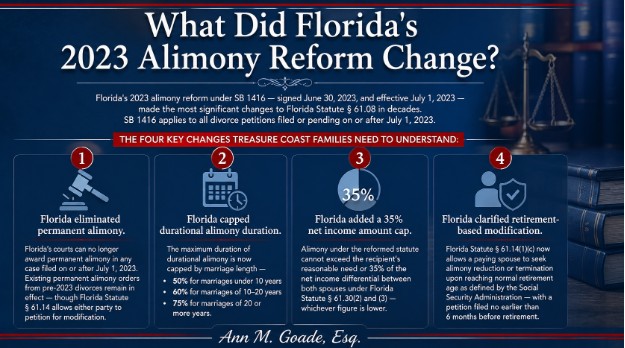
Florida’s 2023 alimony reform under SB 1416 — signed June 30, 2023, and effective July 1, 2023 — made the most significant changes to Florida Statute § 61.08 in decades. SB 1416 applies to all divorce petitions filed or pending on or after July 1, 2023.
The four key changes Treasure Coast families need to understand:
Florida courts can award four types of alimony as of July 1, 2023, under Florida Statute § 61.08, and judges must make written findings of fact explaining which type is awarded and why.
| Type | Purpose | Duration Limit | Modifiable? |
| Temporary | Supports the lower-earning spouse during divorce proceedings | Ends at the final judgment | Yes |
| Bridge-the-gap | Addresses short-term, identifiable financial needs post-divorce | Maximum 2 years | No — not modifiable in amount or duration |
| Rehabilitative | Funds a specific plan to help a spouse become self-supporting through education or job training | Maximum 5 years | Yes — if circumstances change or the plan is completed early |
| Durational | Provides support for a set period based on marriage length | Capped at 50%/60%/75% of marriage length by category | Yes — on a substantial change in circumstances |
Courts may award more than one type of alimony simultaneously when written findings support the combination — so a Treasure Coast spouse may receive both rehabilitative and durational alimony in a single dissolution order.
Alimony mediation in Florida costs significantly less than contested alimony litigation — private family mediation runs $150 to $400 per party per session as of 2026, while a fully contested alimony dispute through the Florida circuit court typically costs $15,000 to $30,000 or more per spouse in attorney fees before trial.
The cost comparison for Treasure Coast families:
Alimony sessions that involve contested income evidence and living expense review typically require 3 to 4 hours of mediation time — so a private alimony mediation session with Ann Goade costs both spouses a combined total well under $2,000 in most cases, compared to the same dispute consuming weeks of litigation at $300–$500 per attorney hour per side.
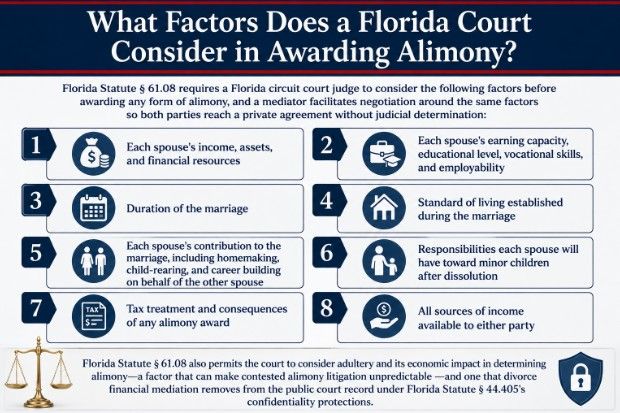
Florida Statute § 61.08 requires a Florida circuit court judge to consider the following factors before awarding any form of alimony, and a mediator facilitates negotiation around the same factors so both parties reach a private agreement without judicial determination:
Florida Statute § 61.08 also permits the court to consider adultery and its economic impact in determining alimony—a factor that can make contested alimony litigation unpredictable —and one that divorce financial mediation removes from the public court record under Florida Statute § 44.405’s confidentiality protections.
Alimony disputes in Martin, Palm Beach, St. Lucie, and Indian River county circuit courts move through the 15th and 19th Judicial Circuits on a court-controlled timeline — and a judge applying the 2023 statutory formula may produce an outcome neither spouse anticipated.
Mediation gives both spouses the following advantages over contested alimony litigation:
Her 30-year exclusive family mediation practice means every alimony session is conducted by a practitioner who has facilitated hundreds of alimony agreements across the Treasure Coast — with no financial stake in the outcome and no active litigation practice creating a conflict.
The 2023 reform created more formula certainty — but not more agreement. Start mediation with Ann Goade today — call (772) 288-7275 or email info@anngoade.com.
Ann Goade conducts alimony mediation sessions using the same structured certified process applied to every Treasure Coast family case — so both spouses understand what to expect before the first session begins.
What is alimony mediation in Florida?
Alimony mediation in Florida is a confidential, certified process in which both spouses negotiate the type, amount, and duration of spousal support with a certified mediator, without a judge applying the statutory formula caps in Florida Statute § 61.08 to their specific case facts.
Did Florida eliminate permanent alimony?
Florida eliminated permanent alimony effective July 1, 2023, under SB 1416, which amended Florida Statute § 61.08. Permanent alimony is no longer available for divorce petitions filed or pending on or after July 1, 2023. Existing permanent alimony orders remain in effect but may be modified under Florida Statute § 61.14.
What types of alimony are available in Florida in 2026?
Florida courts award four types of alimony as of 2026 under Florida Statute § 61.08: temporary alimony during proceedings, bridge-the-gap for up to 2 years, rehabilitative for up to 5 years under a specific plan, and durational alimony capped by marriage length.
How long can durational alimony last in Florida?
Durational alimony under Florida Statute § 61.08 is capped at 50% of marriage length for marriages under 10 years, 60% for marriages of 10 to 20 years, and 75% for marriages of 20 or more years. The amount cannot exceed 35% of the net income differential between spouses.
Can a paying spouse modify alimony when they retire in Florida?
Florida Statute § 61.14(1)(c) allows a paying spouse to petition for alimony reduction or termination upon reaching normal retirement age as defined by the Social Security Administration. A petition may be filed no earlier than 6 months before retirement.
Does mediation keep alimony disputes private in Florida?
Florida Statute § 44.405 protects all communications made during a certified mediation session from disclosure in any subsequent proceeding — so income figures, asset disclosures, and negotiating positions discussed in Ann Goade’s sessions do not enter the public court record.
Can both spouses agree on more alimony than the Florida formula allows?
Both spouses can agree in a Mediated Settlement Agreement to alimony terms that differ from what a Florida circuit court judge would award under the statutory formula — because mediation produces a negotiated agreement, not a court-imposed order. Florida courts approve agreements reflecting both parties’ informed consent.
Does Ann Goade handle alimony mediation for all Treasure Coast counties?
Ann Goade handles alimony mediation for families in Martin, Palm Beach, St. Lucie, and Indian River counties through in-person sessions at her Palm City office and virtual mediation statewide. The same certified neutral process applies across the 15th and 19th Judicial Circuits.


Proudly Serving Areas
Navigation
Practice Areas
Contact Us