

We now offer Virtual Mediations using Enhanced Video Conferencing
Originally published: February 2021 | Updated: September 2026
By Ann M. Goade, Esq., Florida Supreme Court Certified Family Mediator and Family Law Attorney
Child support mediation in Florida is a confidential, certified process in which both parents negotiate child support amount, add-ons, and payment structure under Florida Statute § 61.30 — the income shares model that calculates each parent’s Basic Support Obligation based on combined net income, number of children, timesharing percentage, health insurance costs, and childcare expenses.
Mediation gives both parents control over the final agreement rather than leaving the calculation and any deviations entirely to a circuit court judge. Schedule mediation with Ann Goade — call (772) 288-7275 or email info@anngoade.com.
Florida calculates child support using the income shares model under Florida Statute § 61.30 — combining both parents’ monthly net incomes to determine a Basic Support Obligation from the statutory guidelines schedule, then allocating each parent’s share proportionally based on their percentage of that combined income.
Florida Statute § 61.30(2) defines gross income broadly to include wages, salary, bonuses, commissions, self-employment earnings, rental income, Social Security benefits, disability payments, and investment income.
Net income is calculated after deducting federal and state taxes, FICA contributions, mandatory retirement contributions, and union dues. Courts impute income to a voluntarily unemployed or underemployed parent based on recent work history and prevailing community earnings.
The combined net monthly income determines the Basic Support Obligation from Florida’s guidelines schedule under § 61.30. The schedule covers combined incomes up to $10,000 per month; incomes above that threshold use a percentage-based formula.
Florida Statute § 61.30(8) requires adding to the Basic Obligation:
Each parent’s percentage of combined net income determines their dollar share of the total support obligation — so a parent earning 60% of the combined income pays 60% of the total obligation.
When a parent exercises at least 20% of overnights annually under § 61.30, a timesharing adjustment applies. Florida’s 2023 equal timesharing presumption under Florida Statute § 61.13 — effective July 1, 2023 — means more Treasure Coast cases now involve the gross-up calculation that applies when both parents share substantial overnight time.
Florida’s 2023 timesharing reform under HB 1301 — effective July 1, 2023 — established a legal presumption of equal timesharing under Florida Statute § 61.13, which directly affects child support calculations across Martin, Palm Beach, St. Lucie, and Indian River county cases.
Before July 1, 2023, Florida courts had no presumption for or against equal timesharing — judges determined timesharing based on the best-interest factors without a starting point.
The 2023 reform requires courts to begin with the presumption that both parents share equal time, and requires a parent seeking unequal timesharing to prove by a preponderance of evidence that equal timesharing is not in the child’s best interest.
Equal timesharing triggers the gross-up method under Florida Statute § 61.30, which increases the Basic Obligation by 50% to account for duplicated household costs, then splits the result based on each parent’s income percentage.
The gross-up calculation yields a different — and often lower — transfer payment than the standard calculation because both parents are assumed to cover the child’s household costs.
Mediation gives Treasure Coast parents the ability to negotiate a timesharing schedule and child support amount together — so both figures reflect the actual care arrangement both parents will follow, rather than a court-imposed schedule neither parent designed.
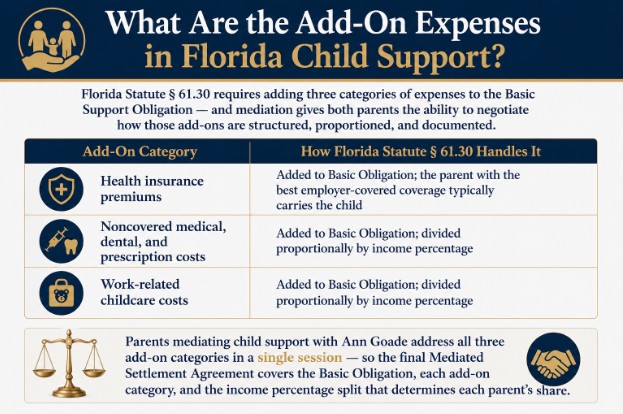
Florida Statute § 61.30 requires adding three categories of expenses to the Basic Support Obligation — and mediation gives both parents the ability to negotiate how those add-ons are structured, proportioned, and documented.
| Add-On Category | How Florida Statute § 61.30 Handles It |
| Health insurance premiums | Added to Basic Obligation; the parent with the best employer-covered coverage typically carries the child |
| Noncovered medical, dental, and prescription costs | Added to Basic Obligation; divided proportionally by income percentage |
| Work-related childcare costs | Added to Basic Obligation; divided proportionally by income percentage |
Parents mediating child support with Ann Goade address all three add-on categories in a single session — so the final Mediated Settlement Agreement covers the Basic Obligation, each add-on category, and the income percentage split that determines each parent’s share.
Florida Statute § 61.30(11)(a) permits a court to adjust the child support amount — upward or downward — when the guideline figure would be unjust or inappropriate given the family’s specific circumstances.
Mediation allows both parents to negotiate an agreed-upon deviation rather than asking a judge to impose one.
Grounds for deviation under Florida Statute § 61.30(11)(a) include:
A court may also deviate from the guideline amount by up to 5% without special written findings if the guideline figure would be unjust, but deviations beyond 5% require the court to enter specific written findings explaining why the standard amount is inappropriate.
Mediation produces an agreed deviation both parents signed, which a circuit court judge reviews and approves as part of a Mediated Settlement Agreement, rather than a contested deviation one parent argued for and the other opposed in open court.
Florida Statute § 61.14 allows either parent to petition for modification of an existing child support order when a substantial change in circumstances has occurred — and mediation provides a certified, confidential path to modify the order without returning to contested proceedings in the 19th or 15th Judicial Circuit courts.
Substantial changes that support modification include:
Ann Goade mediates both initial child support determinations and modification disputes — so Treasure Coast parents facing a changed financial situation resolve the modification through certified mediation rather than filing a contested motion and waiting on court calendar availability.
Parents whose circumstances have changed, schedule mediation directly — call (772) 288-7275 or email info@anngoade.com.
Treasure Coast parents who resolve child support disputes through mediation retain control over the three elements the Florida Statute § 61.30 formula does not resolve on its own: how add-ons are structured, whether any deviation applies, and how future modifications will be handled.
A judge in the 19th or 15th Judicial Circuit court applies the statutory formula and enters an order. Mediation gives both parents the ability to negotiate an agreement that reflects their family’s actual income, childcare costs, and timesharing arrangement — so the Mediated Settlement Agreement is a document both parents helped create rather than a judgment neither parent designed.
Ann Goade’s family law mediation practice has resolved child support disputes for Treasure Coast families since 1993 — so both parents work with a mediator who has facilitated child support agreements across every income range, timesharing structure, and add-on combination the 19th and 15th Judicial Circuits produce.
Three concrete advantages mediation provides over contested child support litigation:
Ann Goade conducts child support mediation sessions using the same structured certified process applied to every Treasure Coast family case.
What is child support mediation in Florida?
Child support mediation in Florida is a confidential, certified process in which both parents negotiate support amount, add-ons, and payment structure under Florida Statute § 61.30 — without a judge applying the statutory formula and entering an order. Both parents reach a Mediated Settlement Agreement that a circuit court judge reviews and approves.
How does Florida calculate child support in 2026?
Florida calculates child support under Florida Statute § 61.30 using the income shares model — combining both parents’ monthly net incomes, applying the statutory guidelines schedule to determine the Basic Support Obligation, adding health insurance premiums and childcare costs, and allocating each parent’s share proportionally based on income percentage.
Does the 2023 equal timesharing law affect child support in Florida?
Florida’s 2023 equal timesharing presumption under Florida Statute § 61.13, effective July 1, 2023, directly affects child support calculations — because equal timesharing triggers the gross-up method under § 61.30, which increases the Basic Obligation by 50% and then splits the result by each parent’s income percentage, producing a different transfer payment than the standard calculation.
Can parents agree to a different child support amount than the Florida guidelines?
Florida Statute § 61.30(11)(a) permits parents to agree to a deviation from the guideline amount when the standard figure would be unjust given their specific circumstances — including extraordinary medical expenses, seasonal income variation, or the child’s special needs. Both parents must document the basis for the deviation in the Mediated Settlement Agreement.
Can child support be modified through mediation in Florida?
Florida Statute § 61.14 allows either parent to seek modification of an existing child support order when a substantial change in circumstances has occurred. Mediation provides a certified, confidential path to negotiate the modification, so both parents can resolve the change without filing a contested motion and waiting on the 19th or 15th Judicial Circuit court calendar.
What expenses are added to the Basic Child Support Obligation in Florida?
Florida Statute § 61.30(8) requires adding health insurance premiums for the child, non-covered medical and dental costs, and work-related childcare expenses to the Basic Support Obligation. Each add-on is divided among parents proportionally to their combined net monthly income under the income shares formula.
Does Ann Goade handle child support mediation across all Treasure Coast counties?
Ann Goade handles child support mediation for families in Martin, Palm Beach, St. Lucie, and Indian River counties through in-person sessions at her Palm City office and virtual mediation statewide. The same Florida Supreme Court-certified neutral process applies across the 15th and 19th Judicial Circuits.
What financial documents should parents bring to child support mediation?
Parents attending child support mediation in Florida should bring recent pay stubs or tax returns documenting gross income, proof of health insurance premium costs for the child, documentation of work-related childcare expenses, and any records of non-covered medical or dental costs — so Ann Goade can facilitate the § 61.30 calculation accurately during the session.


Proudly Serving Areas
Navigation
Practice Areas
Contact Us